
Latttice — the Data Product Workbench for Collibra, now on the Collibra MarketplaceLatttice — the Data Product Workbench for Snowflake70% Less Complexity with LattticeDeliver Trusted Data 80% FasterLower the Cost of Building and Operating Data Products by 70%Latttice is available where business teams work — Slack, Excel, LattticeGPTLatttice the Data Product Workbench brings trusted, fit-for-purpose data to the point of decisionsLatttice the Data Product Workbench is the bridge between the Business and Data TeamsLatttice delivers active governance at the point of data access, so trusted data products are created, controlled, and used with confidenceDesigned in North Carolina, USA
FAQ Comparison

Data-Driven vs Decision-Driven

A direct, plain-language comparison of two very different ways to organize data, governance, analytics, and AI around business decisions.

TL;DR

Data-driven organizations start with the data they have and try to derive insight from it. Decision-driven organizations start with the decisions they need to improve and build trusted data products, workflows, governance, and AI around them.

The difference is not whether data matters. It is whether data activity is the end point, or whether trusted data is designed to support decisions, action and measurable outcomes.

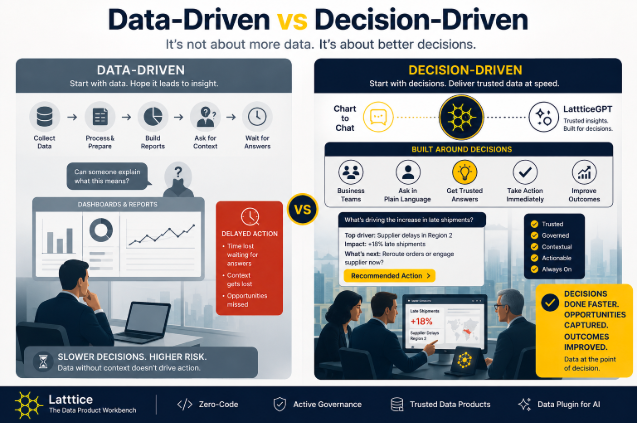
Side-by-side comparison of a data-driven organization versus a decision-driven organization

The Difference at a Glance

Data-driven and decision-driven organizations may use many of the same technologies. The difference is where they start, what they build, and how they measure success.

Traditional model

Data-Driven

Start with available data and work toward an insight.

Collect Data
Prepare Data
Build Reports
Interpret Results
Request Context
Make a Decision

Data-driven organizations focus on collecting, organizing, governing, reporting, and analyzing data. The business often receives the output after technical teams have interpreted the request and built the required report, dashboard, or dataset.

Typical result

More information is available, but leaders may still need help interpreting what it means, whether it can be trusted, and what action should follow.

  • Starts with data
  • Reports and dashboards
  • Context may sit outside the output
  • Interpretation often required
  • Governance may be separate from use
  • Value measured through delivery activity
  • Action can be delayed
The Latttice way

Decision-Driven

Start with the decision and build what is needed to act.

Define Decision
Identify Context
Create Trusted Data Product
Ask in Plain Language
Take Action
Measure Outcome

Decision-driven organizations begin with the decision, the person making it, the required timing, the trusted data and context needed, the governance controls that must apply, and the outcome that will define success.

Typical result

People, workflows, applications, and AI receive trusted, governed, contextual answers at the point of decision.

  • Starts with the decision
  • Trusted data products
  • Business context retained
  • Answers designed for action
  • Governance active during use
  • Value measured through outcomes
  • Faster, more confident decisions

Data-Driven vs Decision-Driven Comparison

Starting point
Data-Driven

The data that is available

Decision-Driven

The decision or outcome that needs to improve

Primary question
Data-Driven

What can the data tell us?

Decision-Driven

What do we need to know, trust, and do?

Main focus
Data-Driven

Data access, analysis, reporting, and insight

Decision-Driven

Decision quality, speed, trust, action, and outcomes

Business role
Data-Driven

The business requests and reviews outputs

Decision-Driven

The business owns intent, context, meaning, and value

Technology role
Data-Driven

Technology teams translate requirements and build outputs

Decision-Driven

Technology provides the governed platform while business teams shape fit-for-purpose products

Typical output
Data-Driven

Reports, dashboards, datasets, and analytics

Decision-Driven

Trusted, governed, fit-for-purpose data products

Context
Data-Driven

Often supplied separately through meetings, analysts, documentation, or tribal knowledge

Decision-Driven

Built into the data product from the beginning

Governance
Data-Driven

May operate as a separate process or control layer

Decision-Driven

Active during creation and consumption

Consumption
Data-Driven

Often requires interpretation from specialists

Decision-Driven

Designed to be understood and used at the point of need

AI readiness
Data-Driven

AI may access data without enough meaning, context, or control

Decision-Driven

AI consumes trusted, governed, contextual data products

Measurement
Data-Driven

Reports created, assets cataloged, sources connected, and projects delivered

Decision-Driven

Decision velocity, decision quality, trust, adoption, and business outcomes

Final result
Data-Driven

More information that may still require explanation

Decision-Driven

Trusted answers that support action

The Shift

The Shift Is Bigger Than Dashboards

The difference between data-driven and decision-driven is not simply the difference between dashboards and conversational AI. It is a change in the operating model.

Data-Driven Operating Model
Data
Platform
Report
Interpretation
Decision

The organization moves data into systems and then asks people to work out how it should influence action.

Decision-Driven Operating Model
Decision
Trusted Data Product
Answer
Action
Outcome

The organization designs trusted data, context, governance, and consumption around a defined decision.

The old model moves data into platforms. The new model moves trusted data into decisions.

Why Can a Data-Driven Organization Still Make Slow Decisions?

A dashboard may show that late shipments have increased by 18 percent. It may identify the affected region, supplier, or product category. But a leader may still need to ask what caused the increase, whether the data is current, what business rules were applied, what exceptions exist, whether the answer can be trusted, and what action should follow.

Those questions may move between the business, analysts, engineers, governance teams, and subject matter experts. The dashboard may be technically correct, but the decision can still arrive too late.

The path from dashboard to decision
  1. Dashboard Delivered
  2. Questions Raised
  3. Context Requested
  4. Logic Checked
  5. Exceptions Explained
  6. Decision Delayed

Data availability is not the same as decision readiness.

Example: Responding to Late Shipments

Data-Driven Path

A supply chain dashboard shows that late shipments have increased by 18 percent. The business asks an analyst to investigate. The analyst checks the reporting logic and requests additional supplier data. An engineer validates the source. A subject matter expert explains a regional exception. The team receives the final interpretation several days later.

Accurate information. Delayed action.
Decision-Driven Path

The organization begins with the decision: How should we respond when late shipments exceed the agreed threshold? A trusted supply chain data product combines shipment performance, supplier information, regional context, contractual obligations, risk thresholds, and governance controls.

A leader asks LattticeGPT what is driving the increase and what action should be taken. The answer identifies the cause, explains the evidence, highlights the affected region, and presents the next available action.

Trusted answer. Immediate action. Measurable outcome.
Sample answer from LattticeGPT
Question
What is driving the increase in late shipments?
Trusted answer
Supplier delays in Region 2 are the leading cause.
Impact
18 percent increase in late shipments.
Recommended action
Reroute priority orders or engage the affected supplier now.

Are Dashboards Still Useful in a Decision-Driven Organization?

Yes. Dashboards remain useful for monitoring, exploration, and communicating performance. The problem is not the dashboard itself. The problem arises when the dashboard becomes the end point and the business is left to work out what the information means and what should happen next.

A Dashboard Commonly Answers
  • What happened?
  • Where did it happen?
  • How much changed?
  • How are we performing?
A Decision-Driven Experience Also Answers
  • Why did it happen?
  • Can the answer be trusted?
  • What context applies?
  • What action is available?
  • What is likely to happen next?
  • How will the outcome be measured?

Chart to Chat and LattticeGPT help users move from viewing information to asking questions in plain language, receiving contextual answers, and identifying the next action without waiting for someone else to explain the result.

Why Are Data Products Central to Decision-Driven Organizations?

Trusted data products form the operating layer between enterprise data foundations and business decisions. They bring together data, business meaning, ownership, quality, policies, lineage, access controls, and consumption methods around a defined purpose.

Warehouses, Lakehouses, Catalogs, Cloud Platforms, Governance Systems and Source Applications
Trusted, Governed Data Products
People, Analytics, Applications, Workflows and AI
Decisions and Outcomes
Data Asset

Something the organization owns or manages.

  • Dataset
  • Table
  • Report
  • Dashboard
  • Semantic model
  • Cataloged asset
Data Product

Something designed for a specific consumer, decision, purpose, and outcome.

  • Business owner
  • Defined purpose
  • Trusted data
  • Business meaning
  • Quality expectations
  • Governance controls
  • Lineage
  • Consumption methods
  • Outcome measurement

How Does the Role of the Business Change?

In a Data-Driven Model

The business often acts as the requester and final consumer.

Business Requirement
Analyst Interpretation
Engineering Build
Governance Review
Business Delivery

Each handoff can introduce delay or reduce the original business context.

In a Decision-Driven Model

The business owns the intent, context, meaning, urgency, and value case.

Business Decision
Governed Creation
Trusted Data Product
Consumption
Outcome

Engineers continue to build and operate the enterprise platform. Business teams shape the products needed for real decisions within governed boundaries.

Engineers should build the platform. The business should own the product.

How Does Governance Differ?

Data-Driven Governance

Governance may operate as a separate process. Assets are cataloged, policies are documented, ownership is assigned, and classifications are added. These controls are important, but they may remain disconnected from the moment when data is created, accessed, or used.

Governance Documented
Decision-Driven Governance

Governance is active within the product and the decision experience. Access rules, sensitivity, permitted use, ownership, lineage, and quality expectations travel with the data product.

Governance Enforced

This means governance is not only evidence that a policy exists. It actively controls what a person, application, or AI agent can see and do.

Why Does Decision-Driven Matter for AI?

AI can generate an answer quickly, but speed does not make the answer trustworthy.

Data-Driven AI

AI has access to data, but may not understand:

  • Which data is approved
  • What the data means
  • How current it is
  • Which business rules apply
  • Who owns it
  • What access controls apply
  • What exceptions exist
  • Whether the result is appropriate for the decision
Fast answer. Uncertain trust.
Decision-Driven AI

AI consumes trusted data products containing:

  • Approved data
  • Business context
  • Definitions
  • Ownership
  • Active access controls
  • Quality expectations
  • Lineage
  • Permitted use
  • Explainable evidence
Trusted answer built for a defined decision.

AI will not repair weak data foundations. It will expose them more quickly.

How Is Success Measured Differently?

Data-Driven Measures
  • Data sources connected
  • Assets cataloged
  • Reports created
  • Dashboards automated
  • Policies documented
  • Projects delivered
  • Data centralized

These measures show activity, but they do not prove that the business is making better decisions.

Decision-Driven Measures
Decision Velocity
How quickly can the organization move from a question to trusted action?
Decision Quality
Did the decision improve the result?
Decision Trust
Can people understand and rely on the data and reasoning behind the answer?
Decision Adoption
Is the product being used in real workflows?
Outcome Value
Did the decision increase revenue, reduce cost, lower risk, improve service, or prevent loss?

Modern data maturity should be judged by outcomes, not output.

Signs of Each Operating Model

Signs You Are Still Primarily Data-Driven
  • Business teams wait for technical teams to interpret requests
  • Dashboards are treated as the final deliverable
  • Data products are mainly renamed technical assets
  • Governance is applied after creation
  • Business context remains in meetings, emails, or individual knowledge
  • Users require analysts to explain reports
  • AI can access data but not its meaning and controls
  • Success is measured through project output
  • The same questions are repeatedly rebuilt
  • Decisions remain slow despite high data availability
Signs You Are Becoming Decision-Driven
  • Work begins with the decision and desired outcome
  • Business teams own intent and context
  • Data products are created for defined consumers and uses
  • Governance is active during creation and consumption
  • Answers are understandable without repeated specialist interpretation
  • People and AI use the same trusted foundation
  • Products are reused across workflows and channels
  • Outcomes are measured
  • Products improve through use and feedback
  • Trusted data reaches the point of decision

What Does a Decision-Driven Workflow Look Like?

1

Define the Decision

Identify the specific decision, the owner, the timing, and the desired outcome.

2

Define the Required Context

Identify the data, definitions, assumptions, business rules, quality expectations, and controls required.

3

Create the Trusted Data Product

Connect and prepare the required data while embedding meaning, ownership, access, lineage, and governance.

4

Make It Consumable

Deliver it through applications, APIs, analytics, Chart to Chat, or LattticeGPT.

5

Act

Enable the person, workflow, application, or AI agent to take the appropriate action.

6

Measure the Outcome

Assess whether the decision improved speed, quality, cost, revenue, risk, or service.

Step 6 loops back to Step 1 as each outcome informs the next decision.
How Latttice fits

How Does Latttice Support a Decision-Driven Organization?

Latttice is the Data Product Workbench built to help organizations create and use trusted, governed data products around real business decisions.

Latttice allows business teams to bring their knowledge, intent, and context into the product creation process without becoming data engineers. It complements the existing data stack and helps close the gap between enterprise data foundations and the point of decision.

Zero-Code Creation

Business teams can shape fit-for-purpose data products around real use cases and decisions.

Business-Led Data Products

Business knowledge, meaning, urgency, and intended value remain connected to the product.

Active Governance

Policies and access controls are applied during build and runtime.

Chart to Chat

Users can move from visual information to natural language questions.

LattticeGPT

People can ask questions in plain language and receive trusted, contextual answers.

Data Plugin for AI

AI agents and applications can use the same governed data products as people and workflows.

No Rip and Replace

Latttice works across the data, cloud, governance, and analytics technologies already in place.

Existing Data Stack
Latttice Trusted Data Products
People, Applications, Workflows and AI
Better Decisions

Frequently asked questions

Is decision-driven the opposite of data-driven?

No. Decision-driven builds on the value of data-driven thinking. Data remains essential, but it is organized around defined decisions and outcomes rather than treated as the end point.

Does decision-driven mean ignoring exploration or discovery?

No. Exploration remains valuable. The distinction is that products intended for operational use are ultimately designed around a clear consumer, decision, action, or measurable outcome.

Are dashboards no longer needed?

Dashboards remain useful for monitoring and exploration. They become more valuable when users can move from viewing information to understanding causes, asking questions, and taking action.

Does decision-driven replace the existing data stack?

No. It complements warehouses, lakehouses, catalogs, governance systems, BI tools, cloud platforms, and source applications. It adds the decision layer that turns those foundations into trusted business use.

Do business users have to become data engineers?

No. Engineers continue to build and operate the platform. Business users contribute the context, definitions, intent, ownership, and value case needed to create fit-for-purpose data products.

Why is decision-driven important for AI?

AI requires more than access to data. It needs trusted data with clear meaning, ownership, quality, lineage, access controls, and permitted use. Decision-driven data products provide that foundation.

How do we begin becoming decision-driven?

Start with one important decision. Define who makes it, what data and context are required, what governance controls must apply, what action should follow, and how the outcome will be measured. Then create the trusted data product needed to support it.

Data-Driven or Decision-Driven?

Data-driven organizations ask: What can we learn from the data we have?

Decision-driven organizations ask: What do we need to know, trust, and do to improve this decision?

That shift changes the starting point, the role of the business, the delivery model, the application of governance, the use of AI, and the definition of success.

The goal is not more data activity. It is trusted data at the point of decision.

Ready when you are

Move From Data Activity to Better Decisions.

See how Latttice helps business teams create trusted, governed data products around the decisions they need to make.

Back to all FAQ Comparisons