Latttice — the Data Product Workbench for Collibra, now on the Collibra MarketplaceLatttice — the Data Product Workbench for Snowflake70% Less Complexity with LattticeDeliver Trusted Data 80% FasterLower the Cost of Building and Operating Data Products by 70%Latttice is available where business teams work — Slack, Excel, LattticeGPTLatttice the Data Product Workbench brings trusted, fit-for-purpose data to the point of decisionsLatttice the Data Product Workbench is the bridge between the Business and Data TeamsLatttice delivers active governance at the point of data access, so trusted data products are created, controlled, and used with confidenceDesigned in North Carolina, USA
FAQ Comparison

Data Mesh vs Data Fabric

A direct, plain-language explanation of what is being compared and why the distinction matters for decisions, governance and AI.

TL;DR

Data Mesh is an operating model that distributes ownership of data to the domains that know it best, treating data as a product. Data Fabric is an architectural pattern that uses metadata, integration and automation to connect data across systems. They are not direct alternatives. Mesh answers who owns data and how it is organized socially. Fabric answers how data is technically integrated and discovered. Most modern organizations end up combining elements of both, with data products as the visible unit of value that sits on top.

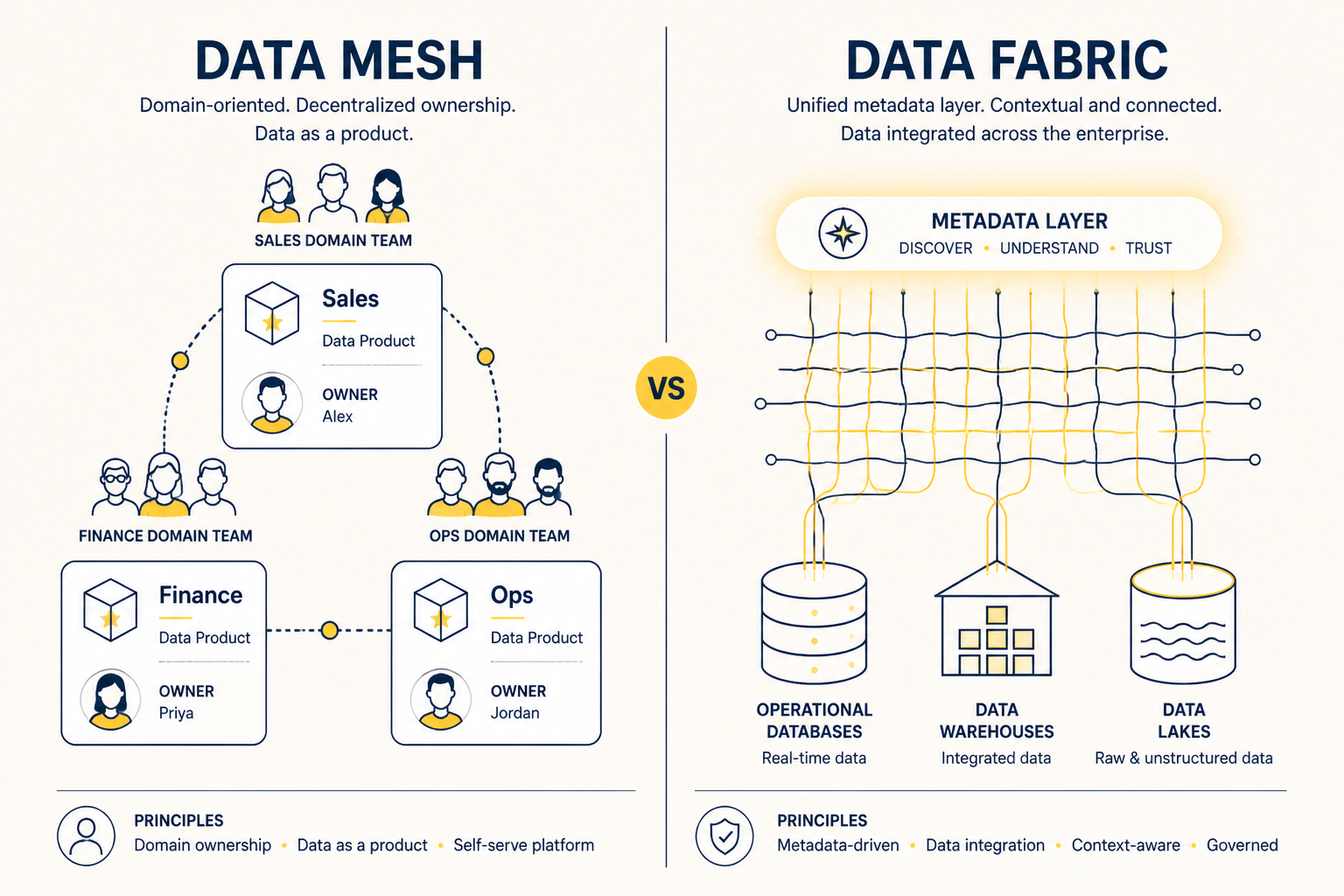
Data Mesh (distributed domain ownership of data products) versus Data Fabric (a woven metadata layer connecting operational databases, warehouses and lakes)
Interactive

Which fits your situation?

Pick the scenario closest to yours and see how Mesh and Fabric each apply.

Your situation

A large enterprise with mature domain teams that already own their business processes end-to-end.

Data Mesh
Strong fit
Data Fabric
Supporting role

Mesh gives domain teams a mandate to own their data as products, with federated governance as the guardrails. A Fabric can sit underneath to make cross-domain integration easier, but the primary shift is organizational.

What is it

Data Mesh

Data Mesh, introduced by Zhamak Dehghani while at Thoughtworks, is an operating model that decentralizes data ownership. Domain teams own their data as products, a self-serve platform provides shared capabilities, and federated governance sets the rules that apply across the organization. It is primarily a socio-technical shift rather than a specific technology.

What is it

Data Fabric

Data Fabric is an architectural pattern that uses active metadata, integration, semantics and automation to weave together distributed data sources. It aims to make data easier to find, understand and use across a heterogeneous landscape, largely through technology rather than through organizational change.

Side-by-side comparison

The most relevant criteria for this comparison, at a glance.

CriterionData MeshData Fabric
Primary purposeDecentralize ownership and treat data as a productIntegrate and enrich data across systems using metadata
OwnershipDomain teams own their data productsCentral platform team typically owns the fabric
UsersDomain teams and product consumersData engineers, stewards and downstream consumers
Operating modelFederated, product-orientedCentralized platform pattern
GovernanceFederated governance with global standardsMetadata-driven governance and automation
ArchitectureAgnostic; enabled by any modern platformSpecific architectural pattern and tooling
OutputsData products owned by domainsIntegrated, discoverable data across sources
Best suited toLarge organizations with strong domain structuresComplex, heterogeneous landscapes needing integration
Relationship to AIProvides ownership and product-thinking for AI-ready dataProvides the integrated, well-described data AI can discover

Key differences

Mesh is an operating model, Fabric is an architecture

Data Mesh is primarily about who owns data and how it is organized. Data Fabric is primarily about how data is connected, described and made available across systems. Confusing the two leads to organizations trying to solve a people problem with a technology purchase, or a technology problem with a reorganization.

Different problems, often at the same time

Many organizations need both: a clear ownership model for data as a product, and a technical fabric that makes distributed sources discoverable and integrated. Choosing between them is rarely the right framing; sequencing them is.

Both benefit from a product lens

Whether you invest in Mesh, Fabric or both, the visible unit of value for the business is a trusted, governed data product. Without that lens, Mesh becomes reorganization for its own sake and Fabric becomes an integration project with no clear business outcome.

When to use each approach

Best fit

Data Mesh

Data Mesh suits large organizations that want domain teams to take real ownership of their data as products, with federated governance and a self-serve platform behind them.

Best fit

Data Fabric

Data Fabric suits organizations with complex, heterogeneous landscapes that need active metadata, integration and automation to make distributed data usable.

Can they work together?

Yes. Mesh and Fabric are complementary. A Data Fabric can provide the connective tissue and metadata backbone that a Data Mesh operating model relies on. Data products then become the visible, business-facing unit of value on top of both.

AI perspective

How AI changes the comparison

AI systems need discoverable, well-described data with clear ownership and business context. Data Fabric contributes discoverability and metadata. Data Mesh contributes ownership and product-thinking. Data products bring the two together in a form AI can actually use responsibly.

Where Latttice fits

A practical role for Latttice

Latttice does not require organizations to replace their existing data platform, warehouse, lakehouse, catalog or governance technology. It provides a zero-code Data Product Workbench that helps business teams find, connect, prepare, govern, publish and use trusted data products around real decisions. Engineering teams continue to own the platforms, controls and foundations. Business teams create the products that turn those foundations into decisions. Active governance operates across both, at build and runtime, so every product remains trusted, fit-for-purpose and ready for AI.

  • Business-built data products
  • Zero-code workbench
  • Active governance at build and runtime
  • No rip and replace
  • Trusted, governed and fit-for-purpose
  • Data at the point of decision
  • Trusted Data Plugin for AI

Frequently asked questions

Is Data Mesh better than Data Fabric?

Neither is universally better. They address different concerns and often work together.

Do I need to choose one?

No. Most mature organizations end up combining elements of both, with data products as the business-facing outcome.

Where do data products fit?

Data products are the unit of value that a Mesh operating model produces and that a Fabric helps expose and integrate.

Which is easier to adopt?

Fabric is often adopted incrementally through tooling; Mesh requires deliberate organizational change.

How does Latttice help?

Latttice lets business teams create governed data products on top of whichever architectures you already run, without rip and replace.

Related guides and comparisons

Ready when you are

See Latttice with your own use case.

Bring us a business challenge, decision or data product idea and we'll show how Latttice can bring it to life — using realistic synthetic data, without requiring access to your private data.

No sales pitch. Just a tailored demonstration for your scenario.

Ready when you are

See Latttice with your own use case.

Bring us a business challenge, decision or data product idea. We'll show how Latttice can bring it to life using realistic synthetic data, without requiring access to your private data.

No sales pitch. Just a tailored demonstration for your scenario.