
One team member
A single business user with context can define, build and publish. No need to pull data engineers out of their existing priorities.
A direct, plain-language explanation of what is being compared and why the distinction matters for decisions, governance and AI.
Engineer-built data products follow a technical delivery model: tickets, handoffs, contracts and engineering sprints. They work for platform-scale engineering, but for business questions they are slow, pull engineers away from other work and often need consultants. Business-built data products let the people closest to the decision create trusted, governed products in a zero-code workbench. Engineers keep the platforms; the business builds the product. The result is faster answers, richer context and far less delivery overhead.
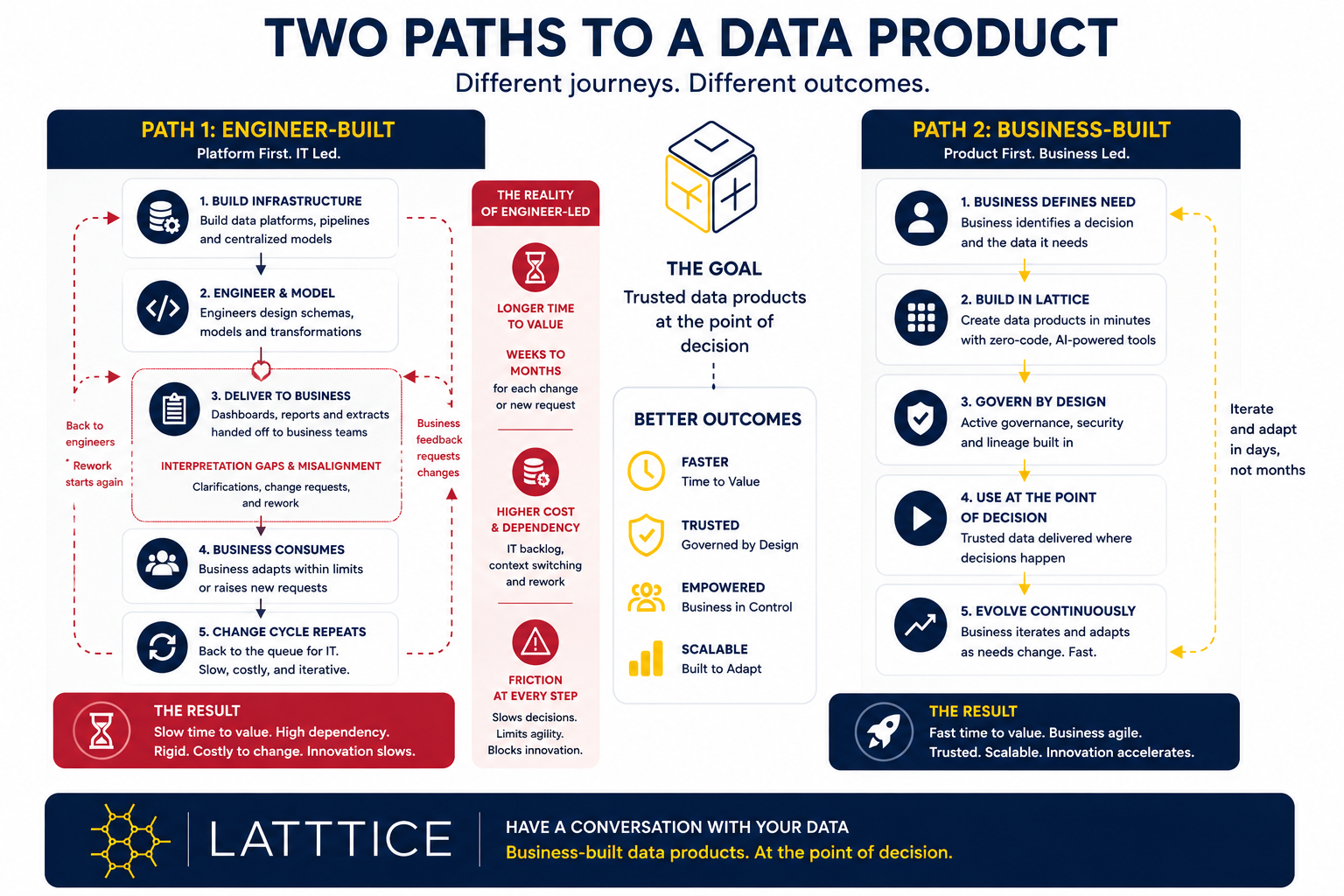
A basic business request never stays basic on the engineer-built path. Every unknown becomes a handoff, every handoff loses context, and every answer arrives with assumptions the business never saw made.
"Show me revenue by customer, this quarter."
Sounds like one query. Here is what actually happens.
Which revenue — booked, invoiced, recognised, net of refunds? Which customer — billing entity, parent, logical group? Which quarter — fiscal or calendar?
Revenue in billing, hierarchy in CRM, refunds in a third system. Engineer writes joins, handles late-arriving refunds and currency.
Pick a grain. Decide on multi-currency, partial periods, cancelled contracts. Choices made for the business, not by them.
Dashboard or extract lands. Business reviews: 'This doesn't match what finance reported.'
Definition changes. Every downstream report using 'revenue' is now subtly inconsistent. Governance debt compounds.
'Great — now by product line.' Start the loop again from step 1.
Before a single line of SQL is written, a whole delivery machine has to assemble around the question — define it, interpret it, contract it, staff it, build it, test it, deliver it. By the time it lands, the business has often moved on.
A need is recognised, framed in business language, and dropped into a backlog owned by a delivery team the requester doesn't sit inside.
Product owners, analysts and engineers translate the request. Several people define, several people interpret — meaning drifts before build begins.
Weeks of iteration on a contract designed to protect engineering's fallback position. It was meant to build trust — it rarely helps the business team asking the question.
One or several data engineers have to be identified, prioritised and pulled off other work. Roadmaps elsewhere slip to make room.
The classic loop: build a version, test against the contract, discover a gap, clarify with the business, rebuild. Repeat until the sprint runs out.
By the time it ships, the market, the campaign or the exec question has moved on. A working product delivered to a stale question is still waste.
Because data engineers and business teams are already stretched, consultants are often brought in to define, oversee or deliver the work.
Everyday commitments mean the internal team rarely has spare capacity. Each extra person — internal or external — adds communication overhead, contract rounds and rework. On the engineer-built path, the cost of one data product can escalate exponentially before anything ships.
Business SME, product owner, analyst, data architect, 1–N data engineers, QA, platform, and a governance reviewer. Every one of them a scheduling problem.
Protects engineering from moving requirements. Rarely gives the business a faster answer, a clearer definition, or a reusable product.
Every engineer withdrawn from another product delays that one too. The cost isn't just this build — it's everything it displaced.
The next question restarts the loop. Definitions drift across teams. Governance debt accumulates in the background.
The business defines revenue once, in context, inside a governed product. The next question reuses the same definition instead of restarting the loop.
No cost figures needed — the difference shows up in time, people, handoffs and whether the answer is still trusted when the next question arrives.
| Dimension | Engineer-built | Business-built with Latttice |
|---|---|---|
| Time to first answer | Weeks to months per question | Days to one week; hours when the question is clear |
| People required | Business SME, product owner, analyst, architect, 1–N engineers, QA, governance reviewer | One business user with decision context |
| Handoffs | Multiple — each one loses context and adds assumptions | One — the person who owns the question builds the answer |
| Technical barrier | SQL, pipelines, deployments and specialist skills required | Zero-code — governed product built inside the workbench |
| Governance | Retrofitted, often after definitions have already forked | Active at build; existing policies from tools like Collibra can be applied directly |
| Reusability | Next question restarts the loop from clarify | Next question reuses the same governed definition |
| Trust | Built through contracts and handbacks — fragile when requirements move | Built by working in sync with safety and compliance built in |
| Consultant dependency | Often required to define, oversee or deliver when internal teams are stretched | Optional for guidance; not required to build |
| Engineer disruption | Engineers pulled from other priorities; roadmaps slip | Engineers stay focused on platform and complex work |
| Outcome when the business moves on | A working product delivered to a stale question — still waste | Products keep pace because the business owns the definition |
Because Latttice is priced by need, not seat, the comparison isn't about dollars — it's about time, people and how many trusted products you can ship before the next planning cycle.
Same target both ways: 50 data products in 12 months — and we're being generous that engineer-built delivery could keep that pace at all. The savings aren't in throughput, they're in what it takes each side to get there.
Business owners define, govern and publish inside the workbench — no delivery queue, no waiting for the next planning cycle.
Data engineering time reclaimed across 50 products — before counting the analysts, SMEs and business owners pulled in alongside them.
Loaded engineering cost avoided across the year — a floor, not a ceiling, once the wider delivery team is added in.
Engineering effort redirected from bespoke delivery to platform, governance and reuse — the work that actually compounds.
Latttice changes the cost structure entirely. A business user with decision context can build a governed, fit-for-purpose data product in about a week — or in hours when the question is already clear. Engineers stay in their roles. Consultants are optional. Trust is restored by working in sync, not by working around each other.
A single business user with context can define, build and publish. No need to pull data engineers out of their existing priorities.
Conservatively one week for a first product. When the decision question is already defined, the first governed answer can be hours away.
Data engineers and business teams stay aligned. Latttice reaches data wherever it lives, while safety and compliance are built in — not retrofitted.
Governance policies are applied as the product is built. If Collibra or another governance tool is already in place, Latttice can activate those policies directly.
No SQL, notebooks or deployment pipelines. Business users build fit-for-purpose products without a technical barrier.
One small internal team can build many data products in the time the traditional path delivers one — without consultant-led blowouts.
A company may choose outside help for initial guidance or implementation, but Latttice does not need consultants to define, oversee or build the product. The platform is designed so a small internal team can deliver many products — and many more answers — in the same window that the engineer-built path produces one.
Swap the metric and the mechanics are identical: an ambiguous term, a round-trip for meaning, engineering choices made on the business's behalf, and forked definitions across the org.
Voluntary vs involuntary. Logo vs revenue. Cohort start date. Downgrades — churn or contraction?
Finance, CS and product each build their own version. Board sees three numbers.
Physical vs available-to-promise. In-transit included? Held for orders? Reserved but unshipped?
Ops, finance and eCom operate on different truths. Overselling and write-offs follow.
Reported vs incurred. Reserves included? Reinsurance net or gross? Currency of record?
Actuarial, finance and reinsurance reconcile for weeks before anyone can act.
In each case, the business-built path replaces the loop with a single governed product — defined by the people who own the decision, and reused wherever the term appears.
Engineer-built data products are designed and delivered by data engineering teams as part of a broader technical delivery cycle. They are usually specified through a request process, built with code, pipelines and platform tooling, and released through structured engineering workflows. This approach is essential for reusable technical services, complex integrations and platform-scale engineering that must serve the whole organization.
Business-built data products are created by the people closest to the business use case, using a zero-code workbench that sits on top of governed data foundations. The business owner defines the decision, the product and the context. Governance, lineage and controls are applied automatically at build and runtime. This model turns data into decisions in minutes or hours rather than joining a long technical delivery cycle.
The most relevant criteria for this comparison, at a glance.
| Criterion | Engineer-Built Data Products | Business-Built Data Products |
|---|---|---|
| Primary owner | Data engineering | Business team closest to the decision |
| Starting point | Technical specification and pipelines | A specific business decision or workflow |
| Language | Code and platform tooling | Business terms in a zero-code workbench |
| Delivery model | Structured engineering release cycles | Iterative, business-led product creation |
| Typical timescale | Weeks to months for a new product | Minutes to hours to move from use case to governed product |
| Governance model | Applied through engineering process | Active governance at build and runtime |
| Business context | Captured through requirements documents | Captured by the business owner in the product |
| Change cycle | Change requests back to engineering | Business owner evolves the product directly |
| Primary output | Reusable technical services and datasets | Trusted, fit-for-purpose data products for decisions |
| Adoption | Driven by technical availability | Driven by the decision the product supports |
| AI readiness | Depends on documentation and downstream work | Business context, governance and lineage built in |
| Measure of success | Platform reliability and reuse | Better, faster, more trusted decisions |
Engineer-built data products remain important where complex infrastructure, reusable technical services and platform-scale engineering are required. Business-built data products solve a different problem. They allow the people closest to the business use case to create governed, fit-for-purpose products around decisions, workflows and outcomes. The two are not in conflict; they operate at different layers of the same landscape.
In an engineering-led model, business context has to travel through requirements, tickets and reviews before it reaches the data product. In a business-led model, the person who understands the decision creates the product directly, so the context is captured once, in the product itself, and stays with it.
Active governance applies policies, lineage, quality checks and access controls at build and runtime. This means business-built products are governed by design, not by review, and remain trusted as they evolve.
Business-built data products can move from use case to governed product in minutes or hours rather than joining a long technical delivery cycle. This does not mean every engineering-built product takes months, but the operating model is fundamentally different.
Engineer-built data products are the right choice for reusable technical services, complex integrations, high-throughput pipelines and platform capabilities that must serve the entire organization. They are also essential when the work is primarily about building the foundations on which other products depend.
Business-built data products are the right choice when the goal is to support a specific decision, workflow or outcome with trusted, governed and fit-for-purpose data. They shine when speed, business context and iteration matter, and when the business owner is best placed to define what good looks like.
Yes, and in most organizations they should. Engineering teams build and maintain the platforms, pipelines, controls and foundations. Business teams use those foundations to create governed, decision-ready products. Governance operates across both. This is the model Latttice is designed to enable.
AI copilots and agents magnify the importance of trusted data, business context and explainability. Business-built data products carry the business meaning, ownership and governance that AI needs to answer questions responsibly. Engineer-built foundations provide the reliable, well-governed sources on which those products depend. Together they give AI the trusted data plugin it needs.
Latttice does not require organizations to replace their existing data platform, warehouse, lakehouse, catalog or governance technology. It provides a zero-code Data Product Workbench that helps business teams find, connect, prepare, govern, publish and use trusted data products around real decisions. Engineering teams continue to own the platforms, controls and foundations. Business teams create the products that turn those foundations into decisions. Active governance operates across both, at build and runtime, so every product remains trusted, fit-for-purpose and ready for AI.
No. Engineering teams remain essential for platforms, pipelines and reusable technical services. Business-built data products complement that work, not replace it.
No. In Latttice, active governance is applied at build and runtime, so every business-built product is governed by design.
Governance is applied by the business owner as the product is created. Because the business owner understands the context, policies, access rules, lineage and quality expectations are captured where the meaning lives, not added later by someone who has to interpret requirements from a distance.
Active governance means controls are applied during the creation of the data product, not after the fact. The data is trusted and ready for decision making, and importantly ready for AI, which is essential because AI needs context, lineage and policy attached to the data it consumes.
Existing governance tools and policies are applied to the data product and made active, rather than remaining in documentation and policies that business teams often treat as an afterthought. Latttice works with those tools so governance becomes part of the product itself.
With a zero-code workbench like Latttice, a business team can move from use case to governed product in minutes or hours, using governed data foundations that engineering already maintains.
The business owner owns fit-for-purpose quality for the decision the product supports. Engineering owns the quality of the underlying platforms and sources.
Business-built data products carry business context, ownership, lineage and governance, which are exactly the attributes AI needs to be trusted.
No. Latttice sits on top of your existing warehouses, lakehouses, catalogs and governance tools. There is no rip and replace.
Bring us a business challenge, decision or data product idea and we'll show how Latttice can bring it to life — using realistic synthetic data, without requiring access to your private data.
No sales pitch. Just a tailored demonstration for your scenario.
Bring us a business challenge, decision or data product idea. We'll show how Latttice can bring it to life using realistic synthetic data, without requiring access to your private data.
No sales pitch. Just a tailored demonstration for your scenario.