What is it
Data Fabric
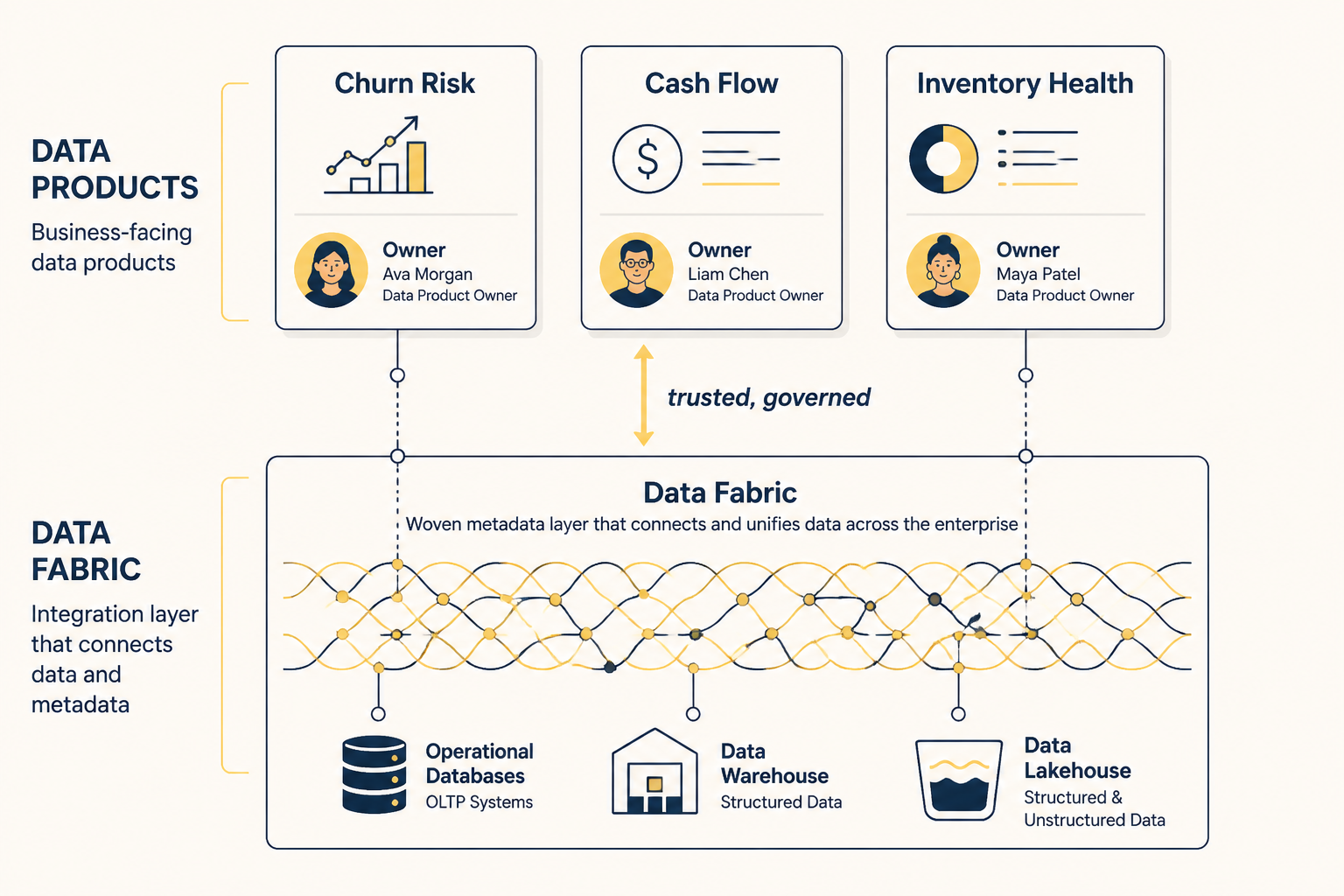
Data Fabric uses active metadata, integration and automation to weave together distributed data across systems, making it easier to discover, describe and integrate.
A direct, plain-language explanation of what is being compared and why the distinction matters for decisions, governance and AI.
Data Fabric is an architectural pattern that uses metadata, integration and automation to connect distributed data. Data products are the trusted, governed, fit-for-purpose units of value that business teams and AI consume. Fabric focuses on how data is technically connected; data products focus on how data is used to make decisions. They are complementary layers, not alternatives.
See where Fabric and data products each earn their keep.
Teams cannot locate authoritative sources; the same metric is calculated three different ways.
Fabric addresses the discovery and metadata problem directly. Data products then codify the agreed definition so the metric stops drifting across teams.
Data Fabric uses active metadata, integration and automation to weave together distributed data across systems, making it easier to discover, describe and integrate.
A data product is a governed, fit-for-purpose unit of data designed around a specific decision or workflow, with a clear owner, lineage and consumption interface.
The most relevant criteria for this comparison, at a glance.
| Criterion | Data Fabric | Data Products |
|---|---|---|
| Layer | Architectural / integration | Business-facing unit of value |
| Primary users | Data engineers and stewards | Business teams, applications and AI |
| Governance | Metadata-driven | Applied to the product and its use |
| Outputs | Integrated, discoverable data | Trusted products around decisions |
| AI readiness | Discoverability and description | Context, trust and fitness for a decision |
Fabric focuses on how data is connected. Data products focus on how data is used. One is plumbing; the other is the unit the business actually asks for.
Fabric primarily serves data specialists. Data products primarily serve the business and AI. Success looks different on each side of the line.
Fabric succeeds when data becomes discoverable and integrated. Data products succeed when they measurably support real decisions, workflows and AI use cases.
Invest in Fabric when the organization needs to integrate and enrich distributed data across a complex landscape.
Invest in data products when the goal is to support specific decisions and workflows with trusted, fit-for-purpose data.
Yes. Fabric provides the connective tissue and metadata backbone that data products can build upon. Data products then become the visible outcome for the business.
AI needs both discoverable data and trusted, fit-for-purpose products. Fabric delivers the first; data products deliver the second. Together they form a strong foundation for enterprise AI.
Latttice does not require organizations to replace their existing data platform, warehouse, lakehouse, catalog or governance technology. It provides a zero-code Data Product Workbench that helps business teams find, connect, prepare, govern, publish and use trusted data products around real decisions. Engineering teams continue to own the platforms, controls and foundations. Business teams create the products that turn those foundations into decisions. Active governance operates across both, at build and runtime, so every product remains trusted, fit-for-purpose and ready for AI.
No. Data products can be built on top of any modern data foundation. Fabric can accelerate discovery and integration.
Neither. They operate at different layers.
Latttice sits at the data product layer, working with whichever underlying architecture you already run.
Bring us a business challenge, decision or data product idea and we'll show how Latttice can bring it to life — using realistic synthetic data, without requiring access to your private data.
No sales pitch. Just a tailored demonstration for your scenario.
Bring us a business challenge, decision or data product idea. We'll show how Latttice can bring it to life using realistic synthetic data, without requiring access to your private data.
No sales pitch. Just a tailored demonstration for your scenario.