Latttice — the Data Product Workbench for Collibra, now on the Collibra MarketplaceLatttice — the Data Product Workbench for Snowflake70% Less Complexity with LattticeDeliver Trusted Data 80% FasterLower the Cost of Building and Operating Data Products by 70%Latttice is available where business teams work — Slack, Excel, LattticeGPTLatttice the Data Product Workbench brings trusted, fit-for-purpose data to the point of decisionsLatttice the Data Product Workbench is the bridge between the Business and Data TeamsLatttice delivers active governance at the point of data access, so trusted data products are created, controlled, and used with confidenceDesigned in North Carolina, USA

FAQ Comparison

RBAC vs ABAC

A direct, plain-language explanation of what is being compared and why the distinction matters for decisions, governance and AI.

TL;DR

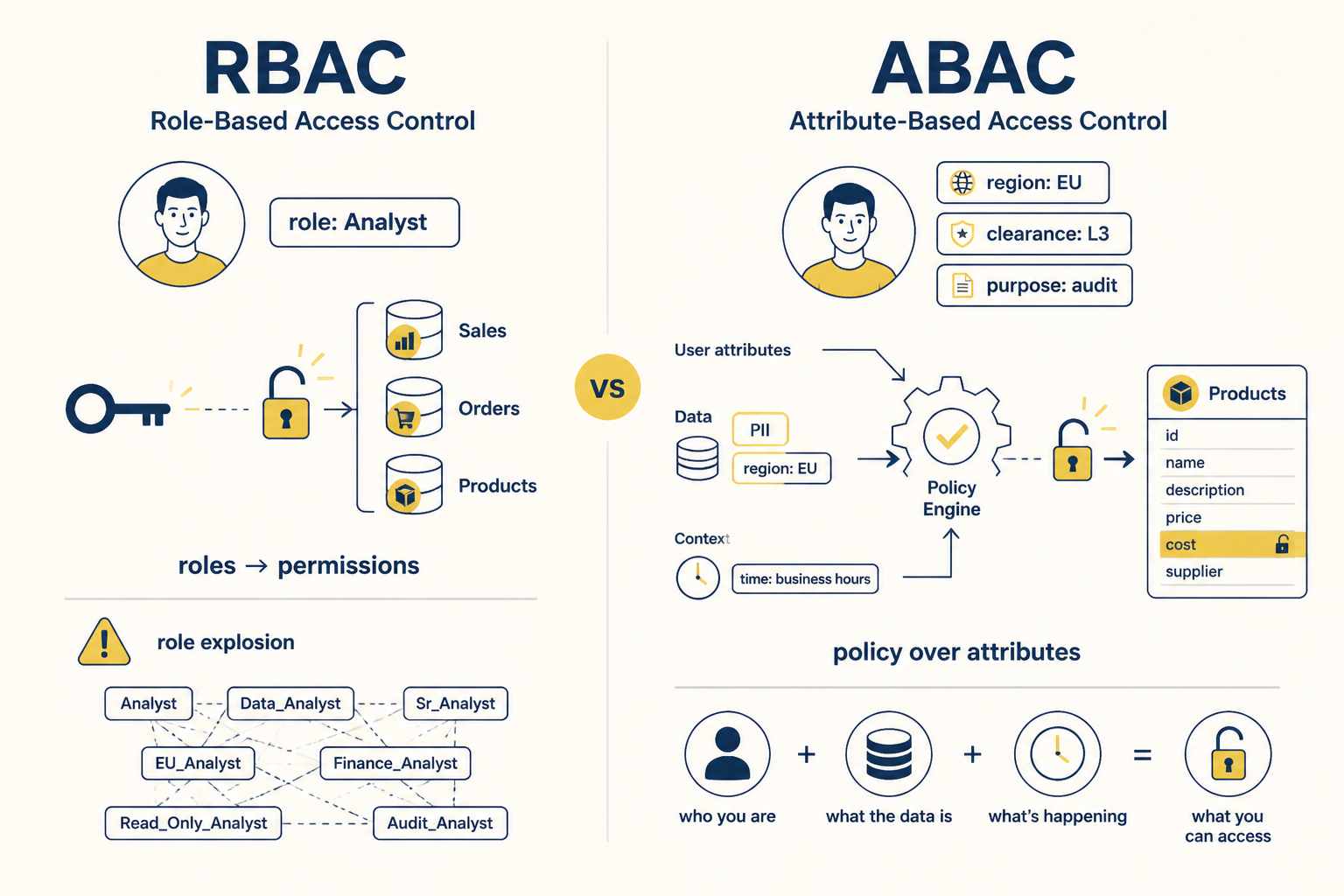
RBAC grants access based on roles assigned to users. ABAC grants access based on attributes of the user, the data, the action and the context. RBAC is simple to reason about but hard to scale. ABAC is more expressive and better suited to fine-grained data products, sensitive data and AI use cases where access depends on context. Most modern enterprises use both, with RBAC for coarse structure and ABAC for policy-driven, fine-grained control.

RBAC shown as a user role granting access to whole data assets with role explosion, versus ABAC shown as a policy engine evaluating user attributes, data attributes and context to grant fine-grained access
Interactive

Which fits your situation?

Choose the situation and see how RBAC and ABAC each apply.

Your situation

A handful of users, no regulated data, and access maps neatly onto job titles.

RBAC
Strong fit
ABAC
Overkill

RBAC is enough. A small set of well-scoped roles will cover the ground without the operational cost of maintaining a policy engine.

What is it

RBAC

Role-Based Access Control grants permissions based on roles assigned to users. Users inherit the permissions of their roles. It is easy to reason about at small scale and maps cleanly to organizational structure, but tends to produce role explosion as the number of edge cases grows.

What is it

ABAC

Attribute-Based Access Control grants permissions based on attributes of the user, the data, the action and the context, evaluated against policies. Access is a decision made at request time, driven by policy rather than by static role assignments.

Side-by-side comparison

The most relevant criteria for this comparison, at a glance.

CriterionRBACABAC
Basis of decisionsRolesAttributes and policies
GranularityCoarseFine
Manageability at scaleRole explosion is commonPolicies scale better
Context-awarenessStaticEvaluated at request time
Fit for sensitive dataLimitedStrong
Fit for AIInsufficient on its ownBetter suited to context-aware access
AuditabilityWho has which roleWhy each request was allowed or denied

Key differences

Roles versus policies

RBAC organizes access by role: a user is a Sales Analyst, and the role carries the permissions. ABAC organizes access by policy over attributes: the same user may be allowed or denied depending on the data, the purpose and the context.

Scale

RBAC often leads to role explosion — hundreds of overlapping roles to encode edge cases. ABAC scales through policy: a small number of policies can cover many combinations of user, data and context.

What gets audited

With RBAC you audit who has which role. With ABAC you audit why each access decision was made, which is the level of evidence sensitive data and AI use cases increasingly demand.

When to use each approach

Best fit

RBAC

Use RBAC for coarse organizational structure and for systems where roles map cleanly to responsibilities. It remains a strong default for many application-level permissions.

Best fit

ABAC

Use ABAC for fine-grained access to sensitive data, cross-boundary sharing, and AI use cases where access depends on user attributes, data classification and context.

Can they work together?

Yes. Most enterprises use both. RBAC provides the coarse organizational structure; ABAC layers on top to make fine-grained, context-aware decisions on sensitive data and AI-driven consumption.

AI perspective

How AI changes the comparison

AI can request data at machine speed and in unexpected combinations. ABAC, evaluated at runtime, is essential to keep access safe and explainable — every request can be scored against user attributes, data classification and purpose before it is answered.

Where Latttice fits

A practical role for Latttice

Latttice does not require organizations to replace their existing data platform, warehouse, lakehouse, catalog or governance technology. It provides a zero-code Data Product Workbench that helps business teams find, connect, prepare, govern, publish and use trusted data products around real decisions. Engineering teams continue to own the platforms, controls and foundations. Business teams create the products that turn those foundations into decisions. Active governance operates across both, at build and runtime, so every product remains trusted, fit-for-purpose and ready for AI.

  • Business-built data products
  • Zero-code workbench
  • Active governance at build and runtime
  • No rip and replace
  • Trusted, governed and fit-for-purpose
  • Data at the point of decision
  • Trusted Data Plugin for AI

Frequently asked questions

Is ABAC replacing RBAC?

No. They are complementary.

Which is better for sensitive data?

ABAC is generally better for fine-grained, context-aware control.

Do we need to rebuild access from scratch to adopt ABAC?

No. Most organizations keep RBAC for coarse structure and add ABAC on top for sensitive data and AI use cases.

How does this relate to active governance?

ABAC is one of the mechanisms active governance uses to enforce policy at runtime, alongside lineage, quality and consumption controls.

Related guides and comparisons

Ready when you are

See Latttice with your own use case.

Bring us a business challenge, decision or data product idea and we'll show how Latttice can bring it to life — using realistic synthetic data, without requiring access to your private data.

No sales pitch. Just a tailored demonstration for your scenario.

Ready when you are

See Latttice with your own use case.

Bring us a business challenge, decision or data product idea. We'll show how Latttice can bring it to life using realistic synthetic data, without requiring access to your private data.

No sales pitch. Just a tailored demonstration for your scenario.