Latttice — the Data Product Workbench for Collibra, now on the Collibra MarketplaceLatttice — the Data Product Workbench for Snowflake70% Less Complexity with LattticeDeliver Trusted Data 80% FasterLower the Cost of Building and Operating Data Products by 70%Latttice is available where business teams work — Slack, Excel, LattticeGPTLatttice the Data Product Workbench brings trusted, fit-for-purpose data to the point of decisionsLatttice the Data Product Workbench is the bridge between the Business and Data TeamsLatttice delivers active governance at the point of data access, so trusted data products are created, controlled, and used with confidenceDesigned in North Carolina, USA

FAQ Comparison

Active Governance vs Traditional Governance

A direct, plain-language explanation of what is being compared and why the distinction matters for decisions, governance and AI.

TL;DR

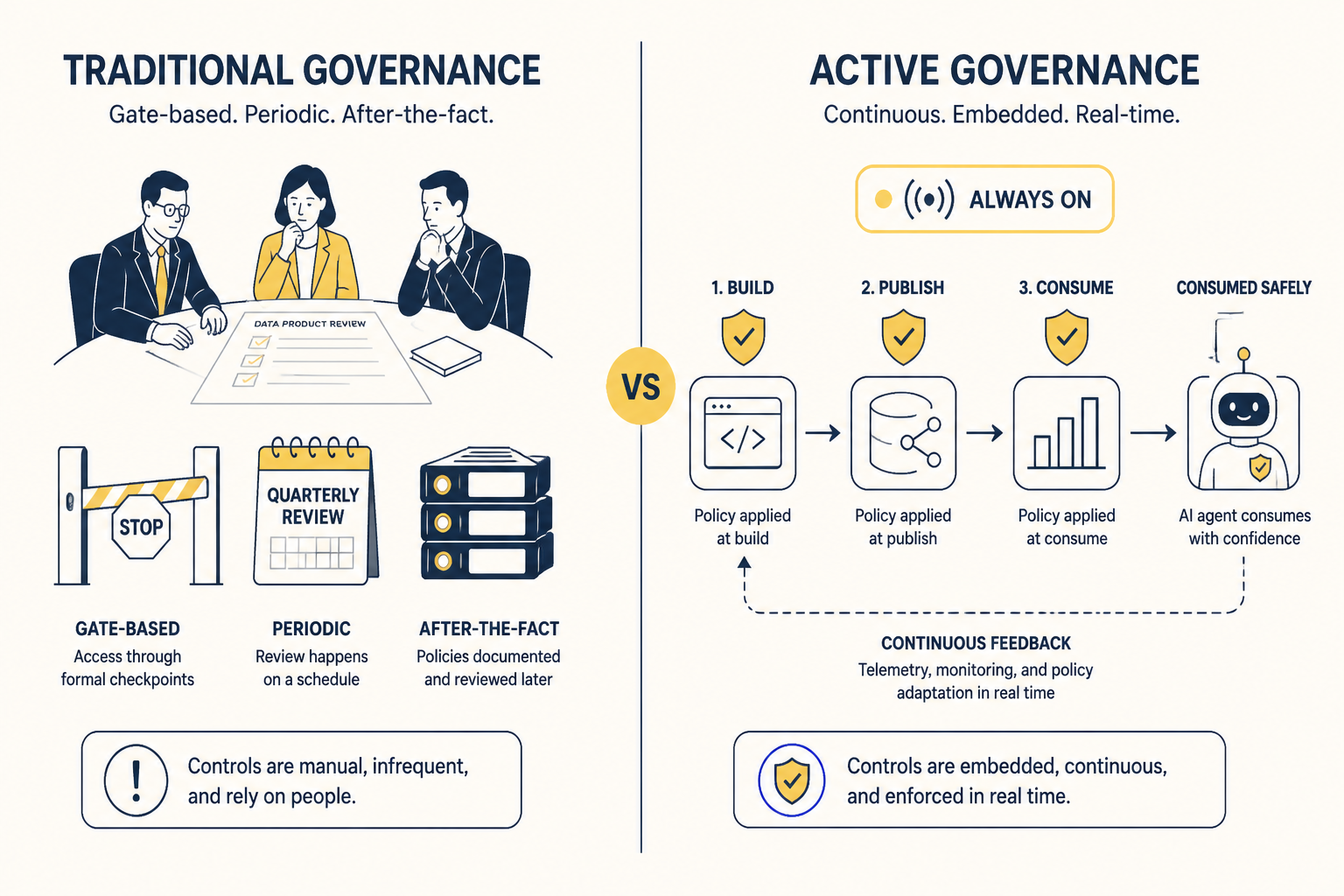
Traditional governance is applied through policies, committees and periodic reviews, largely after data is created. Active governance is applied continuously, at build and runtime, so that every data product is governed by design. Active governance is essential for AI, where speed, scale and unpredictable consumption make review-based models insufficient. Traditional governance still contributes standards and accountability; active governance operationalizes them.

Traditional governance shown as a committee review and periodic gates, versus active governance shown as policy applied continuously at build, publish and consume, feeding safely into AI
Interactive

Which fits your situation?

Pick the situation and see how the two governance models apply.

Your situation

A regulated environment where only a handful of data products exist and change slowly.

Active Governance
Adds precision
Traditional Governance
Still works

Traditional governance can keep up when volumes are low. Active governance adds real value by producing machine-generated evidence auditors can inspect, alongside the existing committee sign-offs.

What is it

Active Governance

Active governance applies policies, lineage, quality checks and access controls continuously, at build and runtime, inside the workbench and at the point of consumption. Controls are embedded in the product itself rather than added after the fact.

What is it

Traditional Governance

Traditional governance defines policies and standards, applies them through committees, reviews and stewardship processes, and audits compliance after the fact. It relies on people, documents and periodic checkpoints rather than continuous automated enforcement.

Side-by-side comparison

The most relevant criteria for this comparison, at a glance.

CriterionActive GovernanceTraditional Governance
When appliedAt build and runtimeThrough review and audit
SpeedContinuousPeriodic
ScaleAutomated across productsLimited by review capacity
Where controls liveIn the product and platformIn documents and committees
AuditabilityMachine-generated evidenceManual sign-offs and reports
Fit for AIStrongInsufficient on its own

Key differences

Governance as a gate versus governance as a fabric

Traditional governance often acts as a gate at release. Active governance runs continuously, inside the product, so trust is maintained as the product evolves rather than certified once and forgotten.

Fit for the speed of AI

AI consumes data at machine speed and in unpredictable combinations. Review-based models cannot keep up. Active governance can, because the controls travel with the product.

Different evidence

Traditional governance produces sign-off documents. Active governance produces machine-generated evidence: lineage, policy decisions, quality checks and access logs captured as the product runs.

When to use each approach

Best fit

Active Governance

Active governance is essential when data products are created and consumed at scale, and whenever AI is part of the picture. It is the only way to keep pace with continuous change.

Best fit

Traditional Governance

Traditional governance remains valuable for setting standards, accountability structures and cross-organization policy that active governance then enforces in practice.

Can they work together?

Yes. Traditional governance defines the rules and the accountability. Active governance operationalizes them at build and runtime. Neither replaces the other; they play different roles in the same governance system.

AI perspective

How AI changes the comparison

AI makes review-based governance impractical. It requests data at machine speed and in unexpected combinations. Active governance is what allows AI to consume trusted data safely at scale, with policy and lineage travelling alongside every request.

Where Latttice fits

A practical role for Latttice

Latttice does not require organizations to replace their existing data platform, warehouse, lakehouse, catalog or governance technology. It provides a zero-code Data Product Workbench that helps business teams find, connect, prepare, govern, publish and use trusted data products around real decisions. Engineering teams continue to own the platforms, controls and foundations. Business teams create the products that turn those foundations into decisions. Active governance operates across both, at build and runtime, so every product remains trusted, fit-for-purpose and ready for AI.

  • Business-built data products
  • Zero-code workbench
  • Active governance at build and runtime
  • No rip and replace
  • Trusted, governed and fit-for-purpose
  • Data at the point of decision
  • Trusted Data Plugin for AI

Frequently asked questions

Is traditional governance obsolete?

No. It defines the rules. Active governance operationalizes them.

Do we need both?

In most enterprises, yes.

How does active governance relate to existing tools like Collibra?

Active governance uses the policies and definitions that live in tools like Collibra and applies them at build and runtime, so governance stops living only in documents.

How does this affect AI?

AI consumption at machine speed makes review-based governance impractical. Active governance is what keeps AI safe, explainable and auditable at scale.

Related guides and comparisons

Ready when you are

See Latttice with your own use case.

Bring us a business challenge, decision or data product idea and we'll show how Latttice can bring it to life — using realistic synthetic data, without requiring access to your private data.

No sales pitch. Just a tailored demonstration for your scenario.

Ready when you are

See Latttice with your own use case.

Bring us a business challenge, decision or data product idea. We'll show how Latttice can bring it to life using realistic synthetic data, without requiring access to your private data.

No sales pitch. Just a tailored demonstration for your scenario.