Latttice — the Data Product Workbench for Collibra, now on the Collibra MarketplaceLatttice — the Data Product Workbench for Snowflake70% Less Complexity with LattticeDeliver Trusted Data 80% FasterLower the Cost of Building and Operating Data Products by 70%Latttice is available where business teams work — Slack, Excel, LattticeGPTLatttice the Data Product Workbench brings trusted, fit-for-purpose data to the point of decisionsLatttice the Data Product Workbench is the bridge between the Business and Data TeamsLatttice delivers active governance at the point of data access, so trusted data products are created, controlled, and used with confidenceDesigned in North Carolina, USA

FAQ Comparison

Data Catalog vs Data Product Workbench

A direct, plain-language explanation of what is being compared and why the distinction matters for decisions, governance and AI.

TL;DR

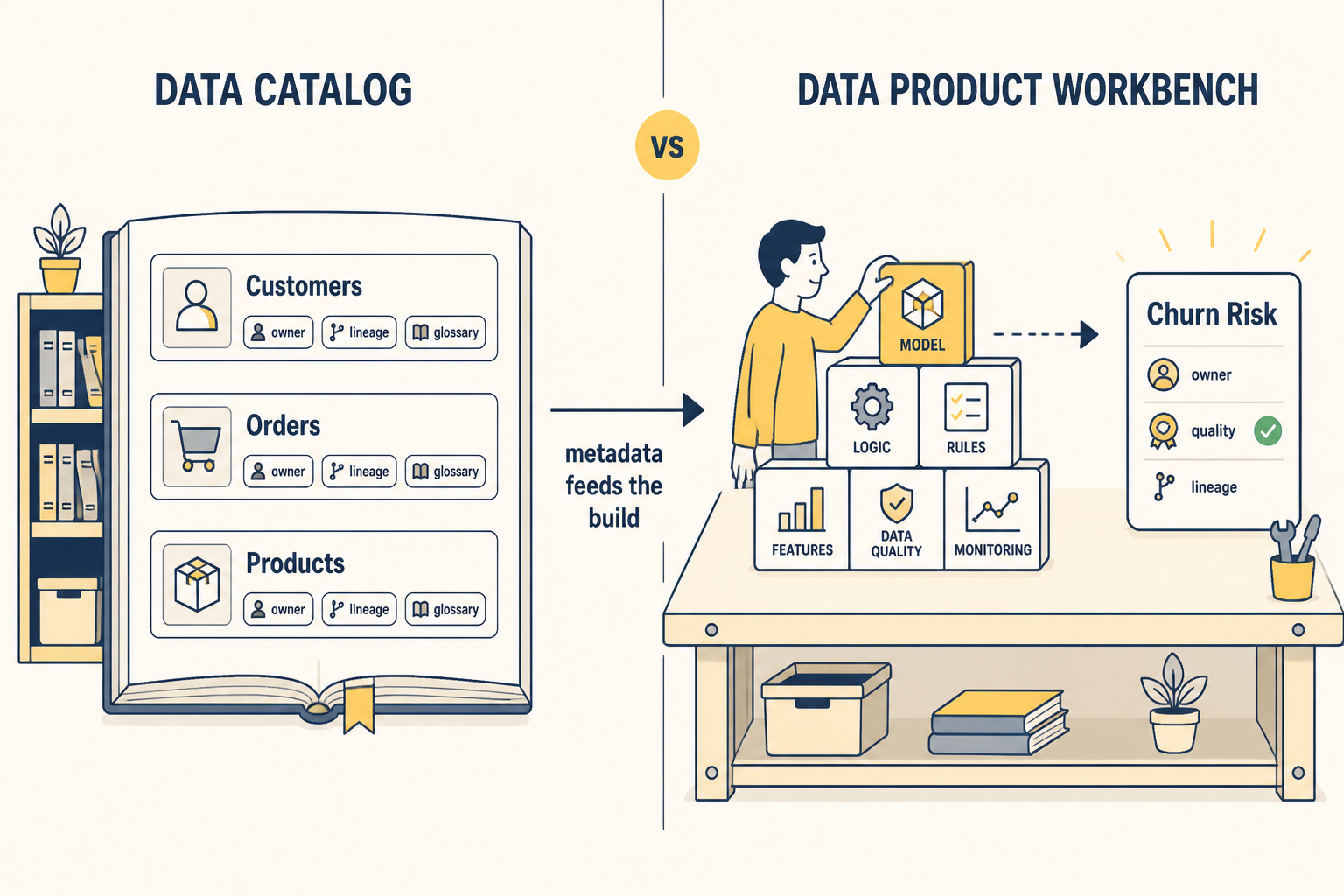
A data catalog is where data assets are described, discovered and governed. A data product workbench is where trusted data products are created, governed and evolved by business teams. Catalogs help you find and understand data. Workbenches help you turn that data into governed products around real decisions. They are complementary, not alternatives.

A data catalog describing data assets (Customers, Orders, Products) alongside a data product workbench where a business owner assembles a governed Churn Risk data product from those assets
Interactive

Which fits your situation?

Pick the situation you recognize and see how a catalog and a workbench each apply.

Your situation

Teams cannot find authoritative sources; the same data is described three different ways across systems.

Data Catalog
Start here
Data Product Workbench
Follows

A catalog fixes discovery and description directly. Once the estate is legible, a workbench turns the described data into products the business can consume.

What is it

Data Catalog

A data catalog inventories, describes and governs data assets across the organization. It provides discovery, lineage, glossary and stewardship capabilities so that people can find data, understand what it means and know who is responsible for it.

What is it

Data Product Workbench

A data product workbench is a zero-code environment where business teams find, connect, prepare, govern, publish and use data products, with active governance built in. It is where the description in the catalog becomes a trusted, decision-ready product.

Side-by-side comparison

The most relevant criteria for this comparison, at a glance.

CriterionData CatalogData Product Workbench
Primary purposeDescribe and discover dataCreate and govern data products
Primary usersStewards and analystsBusiness teams and product owners
OutputDescriptions, lineage, stewardshipTrusted, fit-for-purpose data products
GovernanceMetadata-drivenActive governance at build and runtime
Change modelCurated by stewardsIterated by product owners
AI readinessDiscoverabilityTrusted, context-rich products

Key differences

Describe versus deliver

Catalogs describe what exists. Workbenches deliver what the business can use. A catalog is a map of the landscape; a workbench is where the landscape gets turned into products.

Different users, different skills

Catalogs primarily serve stewards, analysts and engineers who need to inventory the data estate. Workbenches serve business teams and product owners who need to ship a specific outcome.

Different measures of success

A catalog succeeds when the estate becomes discoverable and well-described. A workbench succeeds when governed data products are shipped, adopted and evolved around real decisions.

When to use each approach

Best fit

Data Catalog

Adopt a catalog when the organization needs to inventory, describe and steward its data landscape at scale.

Best fit

Data Product Workbench

Adopt a workbench when business teams need to create trusted data products around real decisions, with governance built in.

Can they work together?

Yes. A workbench uses catalog metadata to help business teams find and understand data, and pushes lineage and stewardship information back to the catalog as products are shipped. Together they cover the full lifecycle from description to delivery.

AI perspective

How AI changes the comparison

AI needs both discoverable data and trusted, governed products. Catalogs make data discoverable. Workbenches turn it into products AI can consume with the context, lineage and policy it needs to answer safely.

Where Latttice fits

A practical role for Latttice

Latttice does not require organizations to replace their existing data platform, warehouse, lakehouse, catalog or governance technology. It provides a zero-code Data Product Workbench that helps business teams find, connect, prepare, govern, publish and use trusted data products around real decisions. Engineering teams continue to own the platforms, controls and foundations. Business teams create the products that turn those foundations into decisions. Active governance operates across both, at build and runtime, so every product remains trusted, fit-for-purpose and ready for AI.

  • Business-built data products
  • Zero-code workbench
  • Active governance at build and runtime
  • No rip and replace
  • Trusted, governed and fit-for-purpose
  • Data at the point of decision
  • Trusted Data Plugin for AI

Frequently asked questions

Do I need a catalog if I have a workbench?

In most large organizations, yes. They cover different parts of the lifecycle.

Does Latttice replace my catalog?

No. Latttice works alongside your existing catalog and governance tools.

Can a catalog do what a workbench does?

No. Catalogs describe data; they are not designed to build governed data products around decisions.

Ready when you are

See Latttice with your own use case.

Bring us a business challenge, decision or data product idea and we'll show how Latttice can bring it to life — using realistic synthetic data, without requiring access to your private data.

No sales pitch. Just a tailored demonstration for your scenario.

Ready when you are

See Latttice with your own use case.

Bring us a business challenge, decision or data product idea. We'll show how Latttice can bring it to life using realistic synthetic data, without requiring access to your private data.

No sales pitch. Just a tailored demonstration for your scenario.