Latttice — Have a conversation with your data
Latttice — the Data Product Workbench for Collibra, now on the Collibra MarketplaceLatttice — the Data Product Workbench for Snowflake70% Less Complexity with LattticeDeliver Trusted Data 80% FasterLower the Cost of Building and Operating Data Products by 70%Latttice is available where business teams work — Slack, Excel, LattticeGPTLatttice the Data Product Workbench brings trusted, fit-for-purpose data to the point of decisionsLatttice the Data Product Workbench is the bridge between the Business and Data TeamsLatttice delivers active governance at the point of data access, so trusted data products are created, controlled, and used with confidenceDesigned in North Carolina, USA
Latttice — Have a conversation with your data
Full Guide

The Enterprise AI Operating Model.

How reusable Data Products create the trusted foundation for AI models, AI agents and business decisions.

AI does not fail because of the model.
It fails because trusted business information is rebuilt for every initiative.
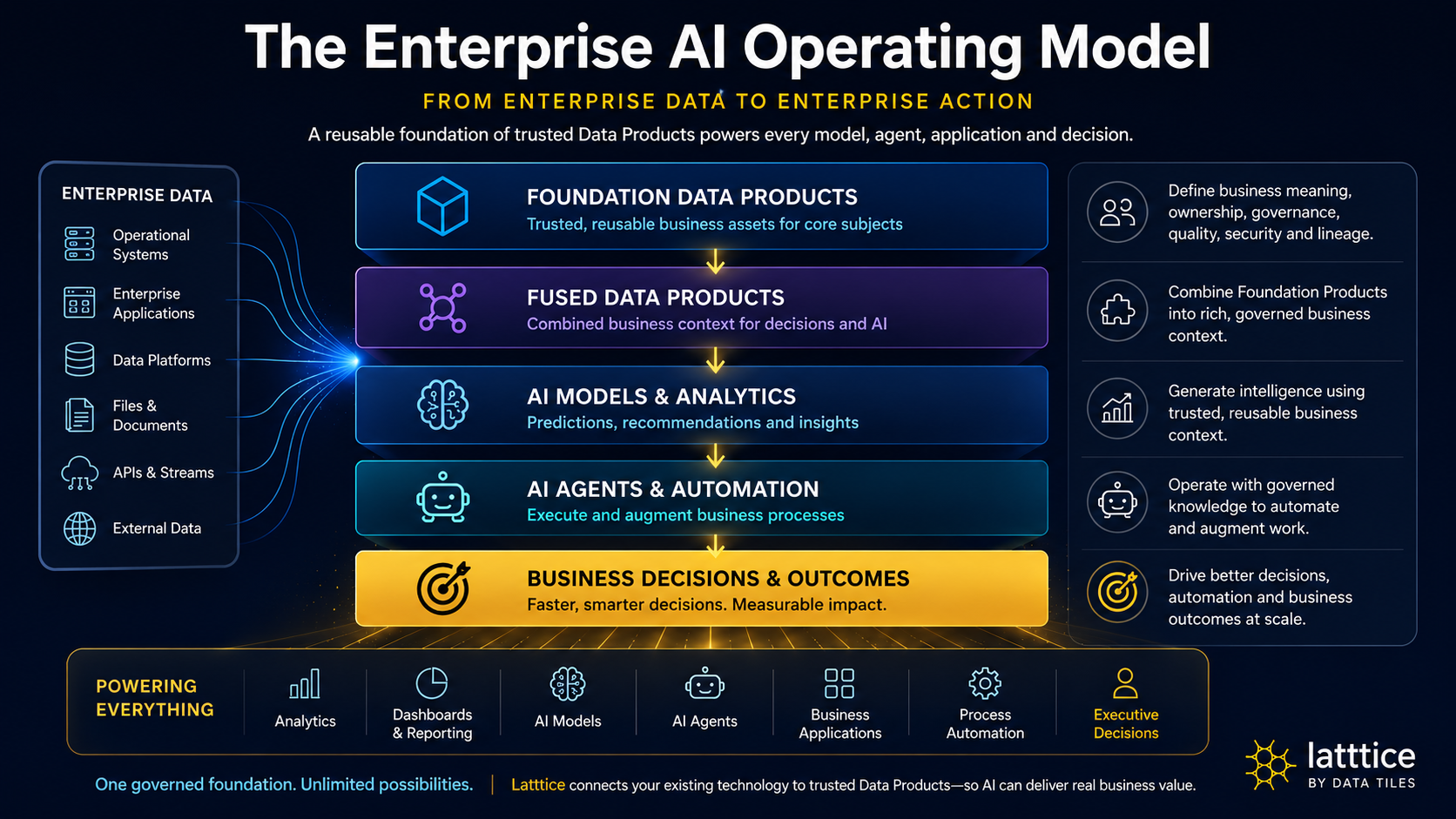
The Enterprise AI Operating Model — a five-layer stack from Foundation Data Products through Fused Data Products, AI Models & Analytics, AI Agents & Automation, to Business Decisions & Outcomes, fed by enterprise data sources and powering analytics, dashboards, AI models, agents, applications, process automation and executive decisions.
Fig 1The Enterprise AI Operating Model. A reusable foundation of trusted Data Products powers every model, agent, application and decision. Enterprise data — operational systems, applications, platforms, files, APIs and external sources — is transformed into Foundation Data Products (trusted, reusable business assets), combined into Fused Data Products (governed business context), and used by AI models, AI agents and business decisions. One governed foundation, unlimited downstream possibilities.
Powered by Latttice — the Data Product Platform for Enterprise AI
Enterprise DataData ProductsAI IntelligenceEnterprise Action
Full Guide · Page 01 / 10
Enterprise AI Has Reached a Turning Point
Full Guide · Page 02 / 10

Access to AI models is no longer the defining challenge. Access to trusted business context is.

Enterprises have invested in data platforms, cloud infrastructure, governance systems, analytics tools and AI technology. Yet many AI initiatives remain slow to deliver value and difficult to scale.

The problem is not a lack of data. It is that business information remains fragmented across operational systems, applications, reports, warehouses, catalogues and departmental processes.

Before an AI model or agent can deliver a reliable outcome, teams must determine which data is correct, what it means, who owns it, how it may be used and whether it can be trusted. That work is repeatedly recreated for every initiative.

The next stage of Enterprise AI requires more than another model or platform. It requires a reusable operating model for trusted business information.

Every AI initiative should not have to rediscover the enterprise.
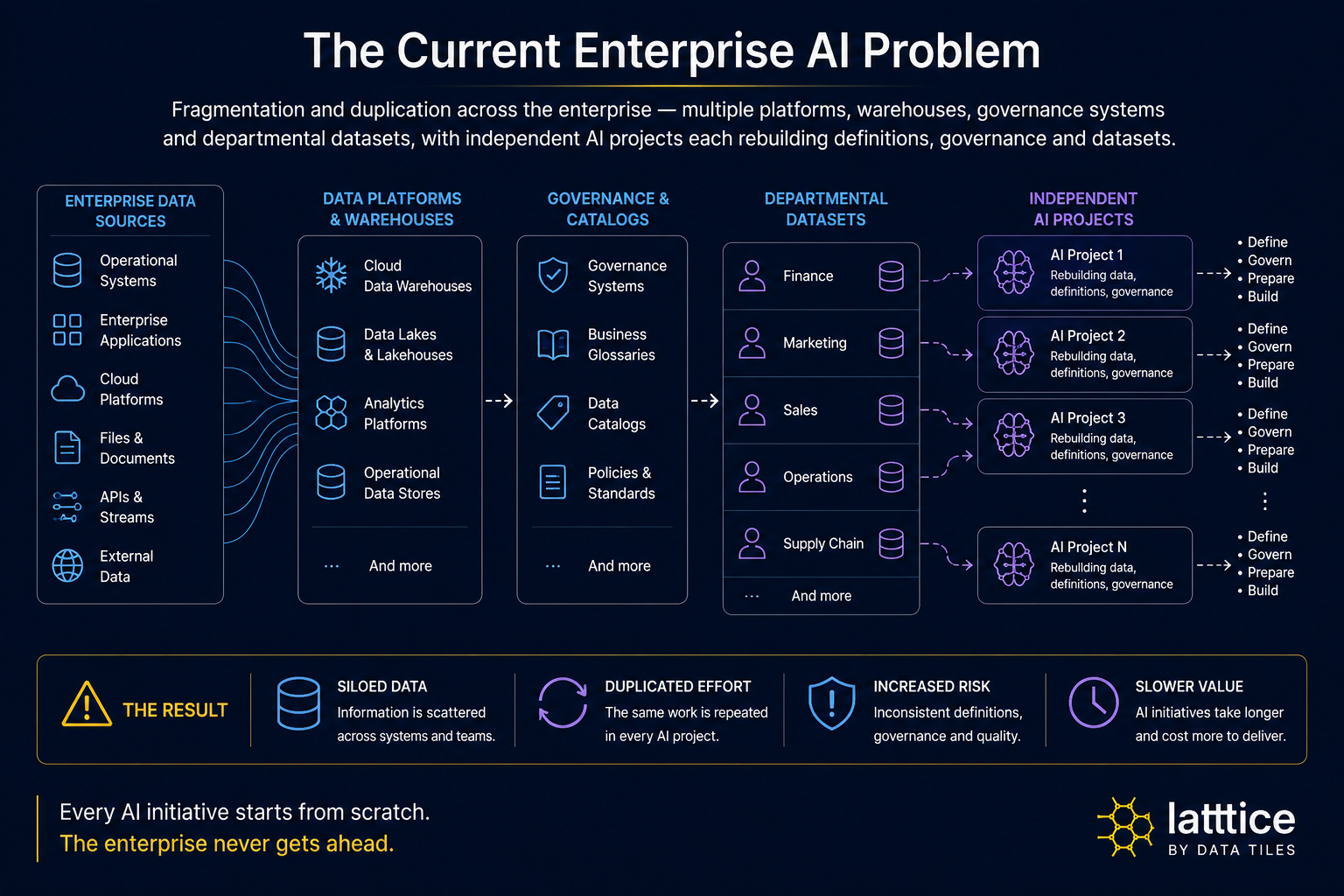
The Current Enterprise AI Problem — fragmentation and duplication across enterprise data sources, platforms, warehouses, governance catalogues, departmental datasets and independent AI projects, each rebuilding definitions, governance and datasets.
Fig 2The Current Enterprise AI Problem. Fragmentation and duplication across the enterprise — multiple platforms, warehouses, governance systems and departmental datasets — force every independent AI project to rebuild definitions, governance and datasets from scratch. The result is siloed data, duplicated effort, increased risk and slower value, because every AI initiative starts from scratch and the enterprise never gets ahead.
Enterprise DataData ProductsAI IntelligenceEnterprise Action
Full Guide · Page 02 / 10
Why AI Does Not Scale
Full Guide · Page 03 / 10

AI pilots are often built as isolated projects rather than reusable enterprise capabilities.

Data lives across disconnected systems.
Business definitions vary across teams.
Trusted information is difficult to identify.
Governance is applied inconsistently.
Each initiative rebuilds similar data.
Business users cannot confidently interpret AI outputs.

The result is slow delivery, duplicated investment, inconsistent outcomes and AI pilots that never become repeatable enterprise capabilities.

This is not primarily a model problem. It is an operating model and architecture problem.
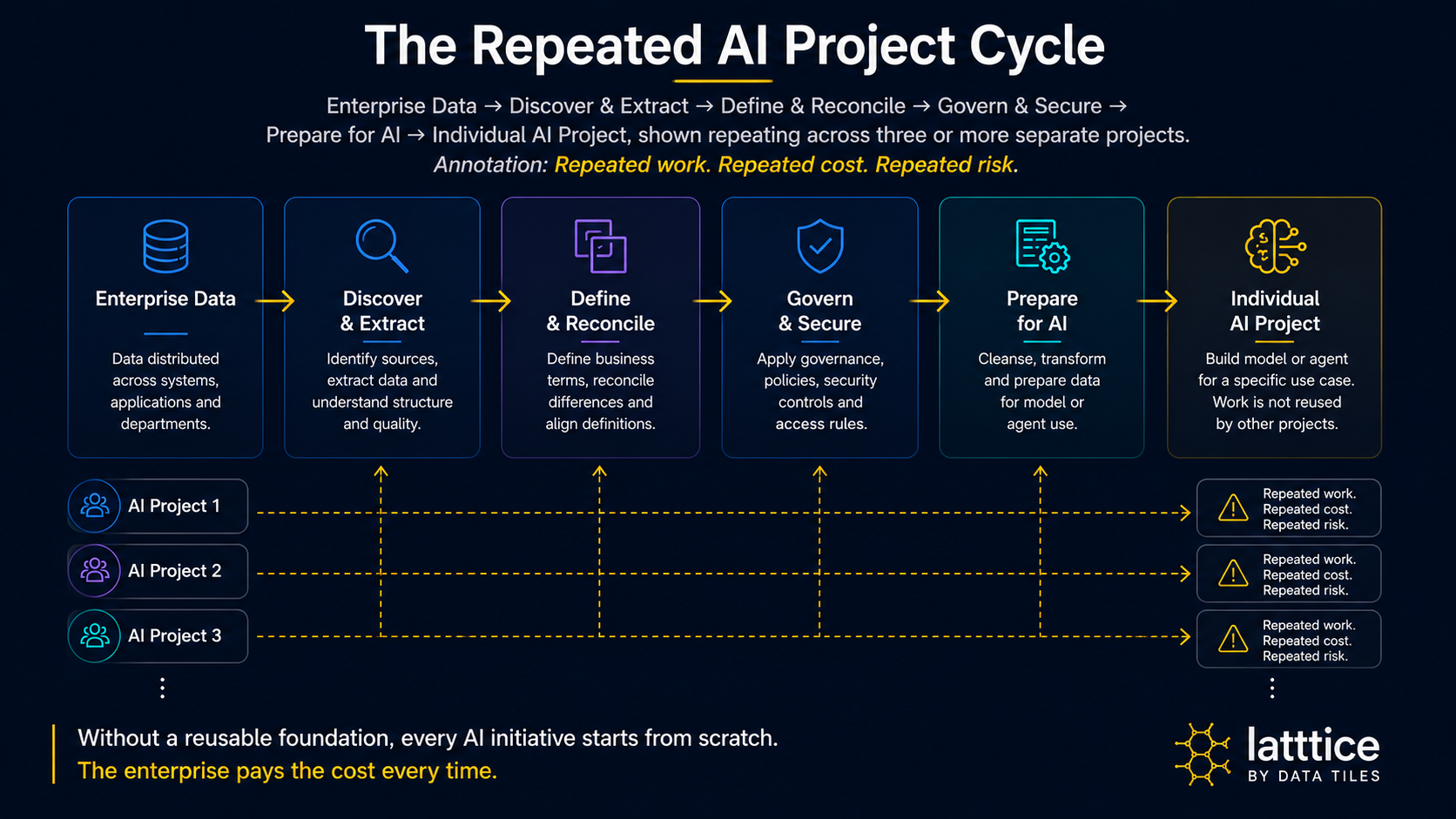
The Repeated AI Project Cycle — Enterprise Data flows through Discover & Extract, Define & Reconcile, Govern & Secure and Prepare for AI, then repeats separately for AI Project 1, AI Project 2, AI Project 3 and beyond, creating repeated work, cost and risk.
Fig 3The Repeated AI Project Cycle. Without reusable Data Products, every AI initiative rediscovers, reconciles, governs and prepares the same enterprise data from scratch. Each project repeats the same work, accumulates the same cost and reintroduces the same risk — while the enterprise pays the price every time.
Enterprise DataData ProductsAI IntelligenceEnterprise Action
Full Guide · Page 03 / 10
The Operating Model
Full Guide · Page 04 / 10

A reusable operating model for Enterprise AI.

Latttice changes the sequence. Rather than building AI directly on top of fragmented enterprise data, the organization creates reusable Data Products first.

These Data Products establish trusted business meaning, governance and context once, so they can be reused across many AI initiatives.

1
Foundation Data Products
Trusted, reusable representations of core business subjects.
2
Fused Data Products
Combined subjects for richer business and decision context.
3
AI Models
Predictions, recommendations, classifications and forecasts.
4
AI Agents
Use trusted information and models to support or execute processes.
5
Business Outcomes
Better decisions, automation, customer experiences and performance.
Build the trusted foundation once. Reuse it across every AI capability.
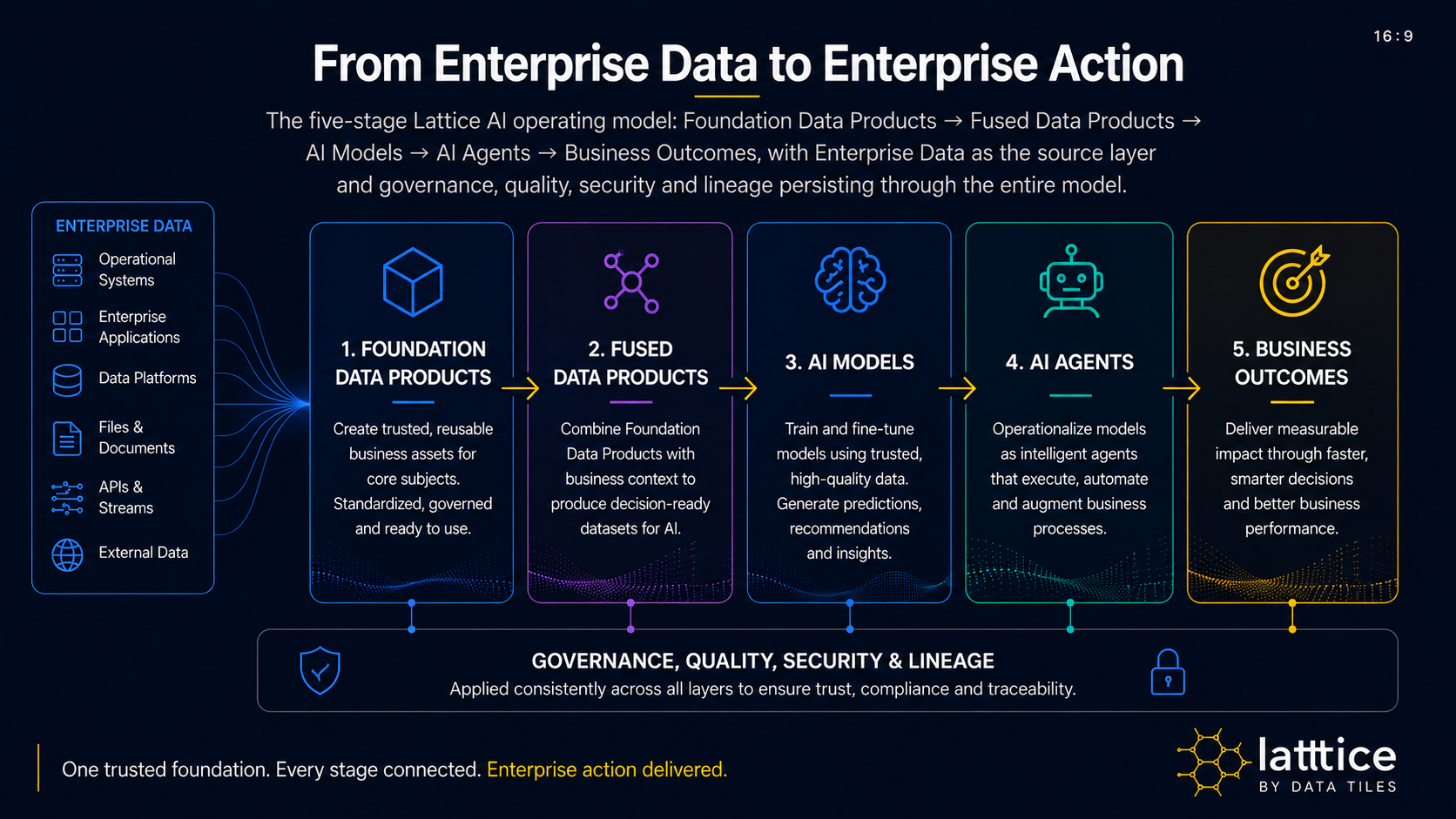
From Enterprise Data to Enterprise Action — the five-stage Latttice AI operating model showing Enterprise Data feeding into Foundation Data Products, Fused Data Products, AI Models, AI Agents and Business Outcomes, with governance, quality, security and lineage applied consistently across all layers.
Fig 4From Enterprise Data to Enterprise Action. The five-stage Latttice AI operating model: Foundation Data Products → Fused Data Products → AI Models → AI Agents → Business Outcomes, with Enterprise Data as the source layer and governance, quality, security and lineage persisting through the entire model. One trusted foundation connects every stage, so enterprise action is delivered repeatedly and at scale.
Enterprise DataData ProductsAI IntelligenceEnterprise Action
Full Guide · Page 04 / 10
Foundation Data Products
Full Guide · Page 05 / 10

A Foundation Data Product is not simply another dataset. It is a trusted, reusable business asset.

Each Foundation Data Product represents an important business subject using an agreed definition, governed access and accountable ownership.

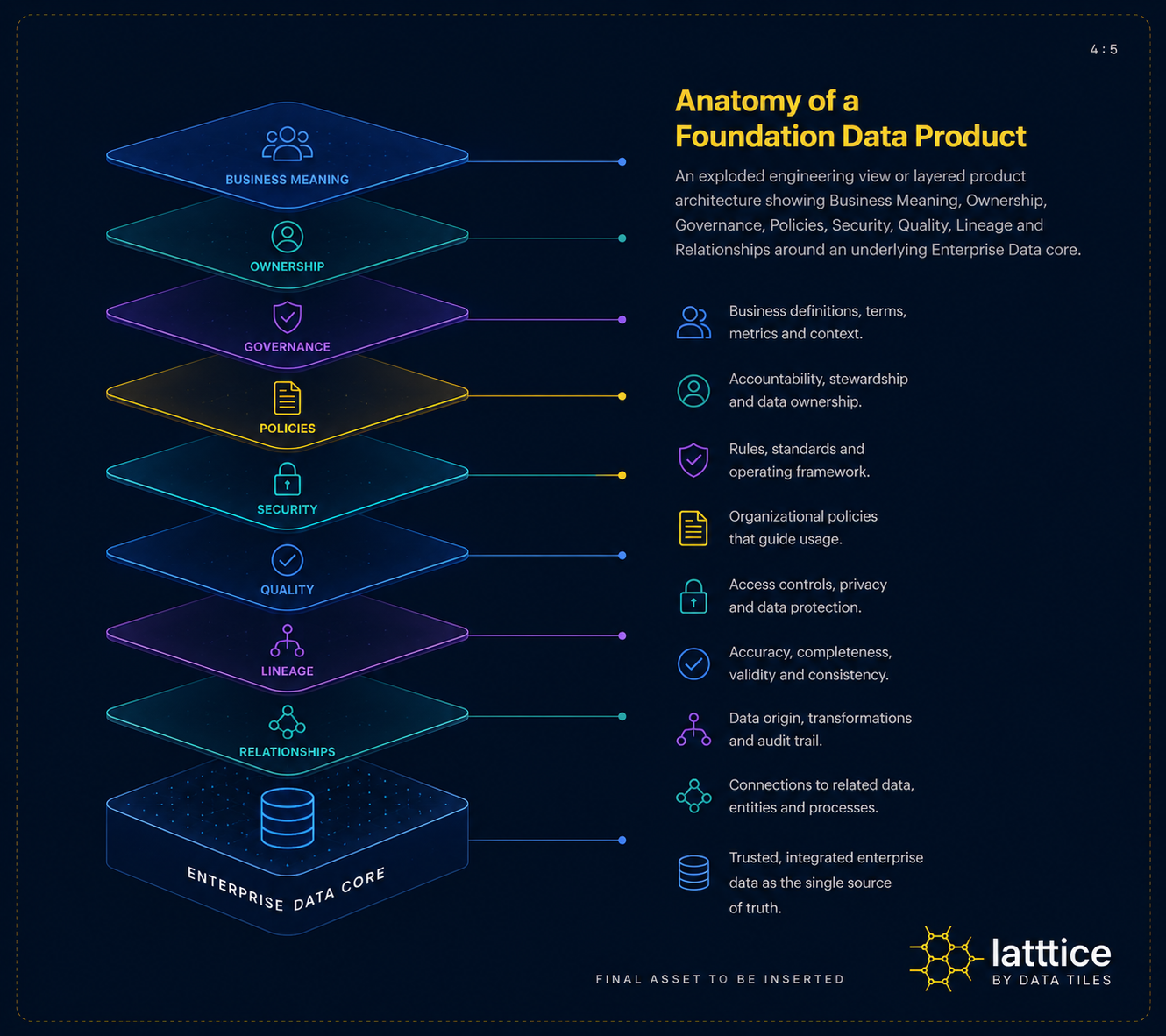
A Foundation Data Product brings together the information and controls required for safe enterprise reuse: business meaning, ownership, governance, quality, security, lineage, policies and relationships.

Foundation Data Products become the reusable building blocks for analytics, applications, AI models and AI agents.
Examples
CustomerProductFinanceAssetsSuppliersWorkforce
Anatomy of a Foundation Data Product — a layered product architecture with Enterprise Data Core at the base and successive layers for Relationships, Lineage, Quality, Security, Policies, Governance, Ownership and Business Meaning, each with defined business definitions, accountability, rules, access controls, accuracy standards, transformations and connections.
Fig 5Anatomy of a Foundation Data Product. A Foundation Data Product is a layered, governed business asset built around a trusted Enterprise Data Core. Each layer adds reusable enterprise capability: Business Meaning (definitions, terms, metrics and context), Ownership (accountability and stewardship), Governance (rules and standards), Policies (organizational usage guidance), Security (access controls, privacy and data protection), Quality (accuracy, completeness, validity and consistency), Lineage (origin, transformations and audit trail) and Relationships (connections to related data, entities and processes). Together these layers make a Foundation Data Product safe, understandable and reusable across AI, analytics and applications.
Customer is not a table. It is an agreed and governed business concept.
Enterprise DataData ProductsAI IntelligenceEnterprise Action
Full Guide · Page 05 / 10
Fused Data Products
Full Guide · Page 06 / 10

AI rarely reasons over a single business subject. It needs complete business context.

Foundation Data Products establish trusted representations of individual business subjects. Fused Data Products combine those reusable assets into richer context for a specific decision, process or AI use case.

Fusion is not simply another technical join. It creates a reusable and governed view of how multiple business subjects relate to one another.

Customer Intelligence
Customer + Service + Digital + Product + Finance
Supply Chain Intelligence
Inventory + Orders + Logistics + Suppliers
Claims Intelligence
Policies + Claims + Risk + Customer
Foundation Data Products define the business. Fused Data Products explain what is happening across it.
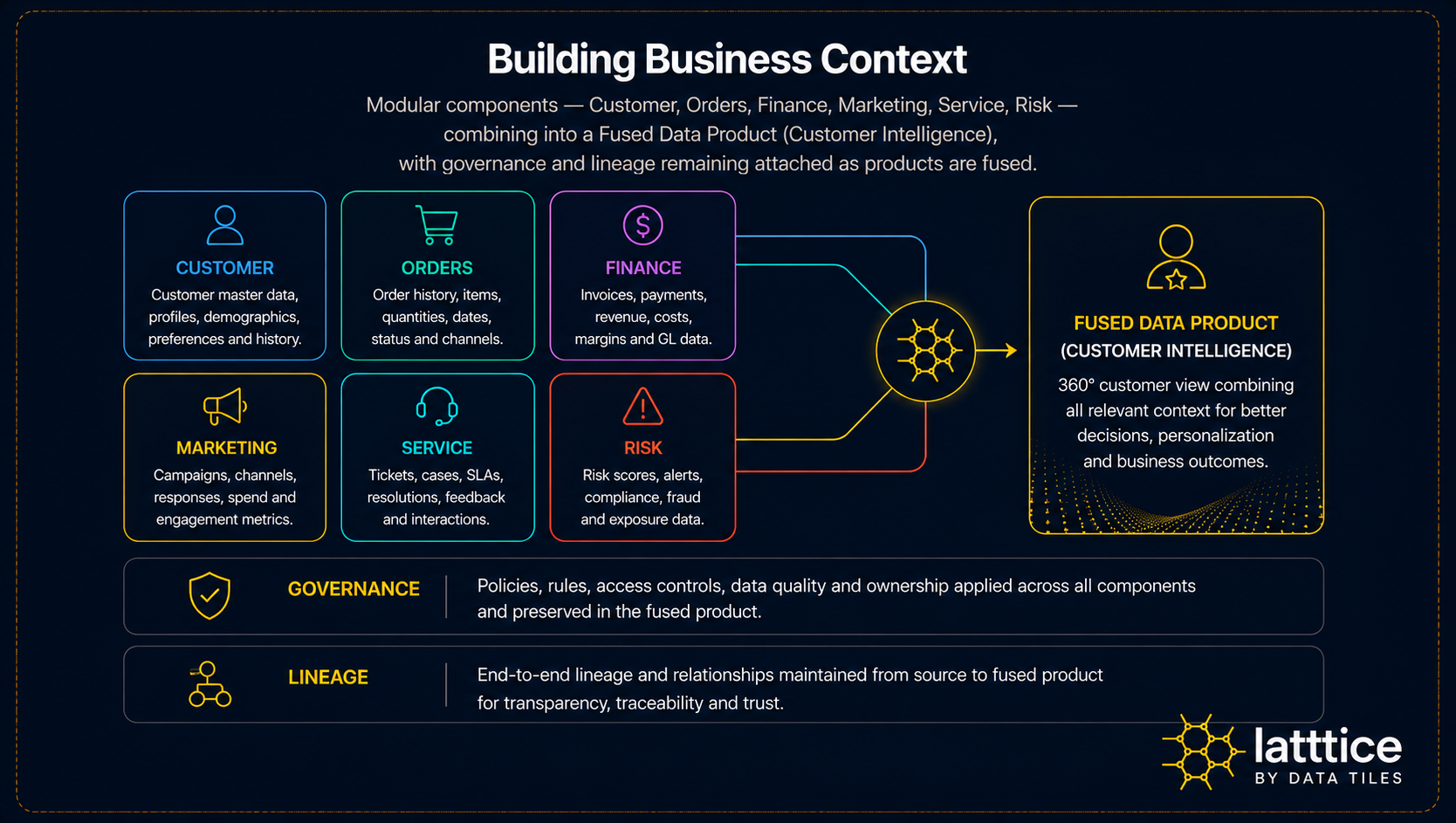
Building Business Context — modular Foundation Data Products for Customer, Orders, Finance, Marketing, Service and Risk combining into a Fused Data Product (Customer Intelligence), with governance and lineage preserved across every component.
Fig 6Building Business Context. Foundation Data Products for Customer, Orders, Finance, Marketing, Service and Risk are designed as modular, governed components. When fused, they create a reusable Data Product such as Customer Intelligence — a 360° view that combines all relevant business context for decisions, personalization and outcomes. Importantly, governance, policies, access controls, data quality and lineage remain attached as products are fused, so the resulting business context is trusted, traceable and ready for AI, analytics and applications.
Enterprise DataData ProductsAI IntelligenceEnterprise Action
Full Guide · Page 06 / 10
AI Models
Full Guide · Page 07 / 10

Models should consume trusted Data Products — not create another isolated data pipeline.

AI models consume Fused Data Products to identify patterns, generate predictions and make recommendations. Because models use reusable Data Products, teams do not need to recreate definitions, governance and preparation for every use case.

The same trusted business context can support many model capabilities — prediction, recommendation, forecasting, classification, risk detection and optimization. Examples include churn prediction, fraud detection, predictive maintenance, customer lifetime value, next best action and claims risk.

As the Data Products improve, every model that consumes them benefits.

Improve the Data Product once. Strengthen every model that depends on it.
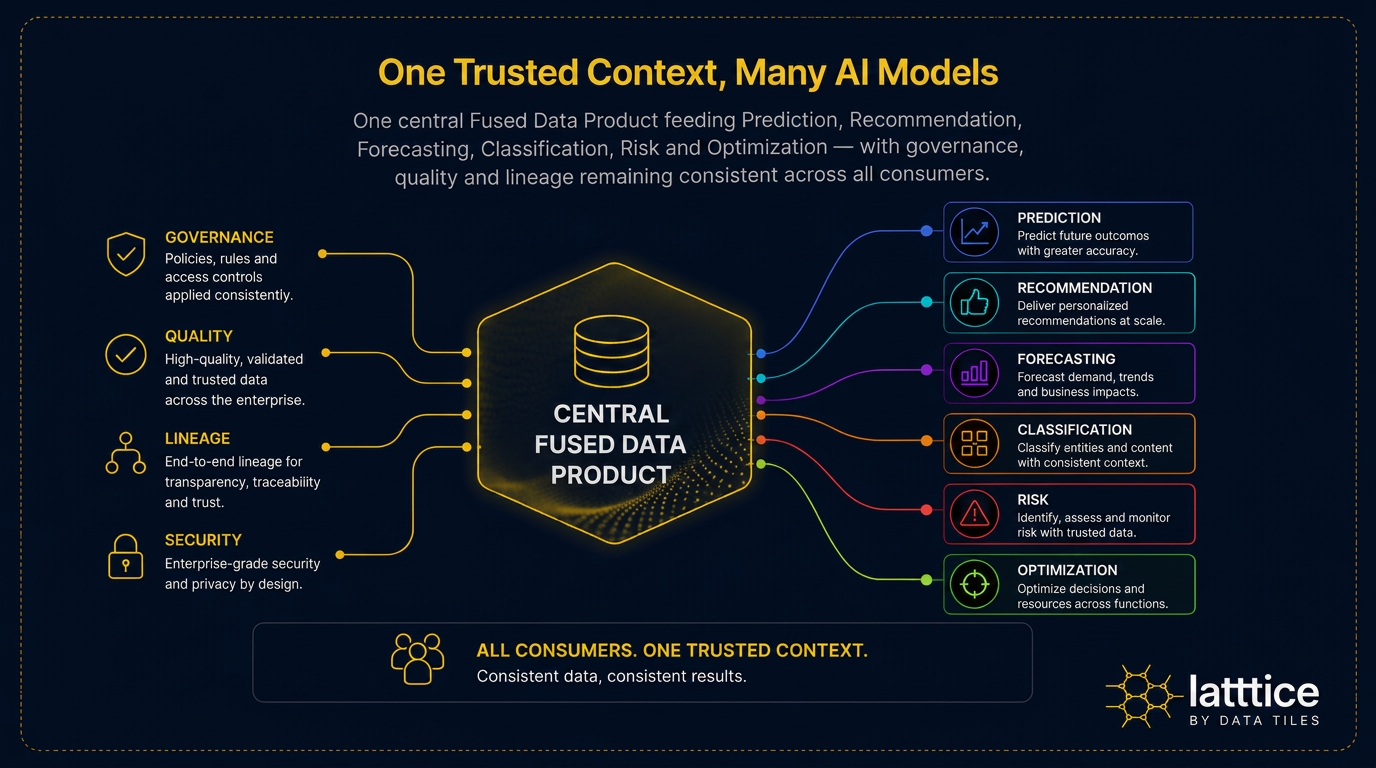
One Trusted Context, Many AI Models — a central Fused Data Product feeds Prediction, Recommendation, Forecasting, Classification, Risk and Optimization, while Governance, Quality, Lineage and Security remain consistent across every consumer.
Fig 7One Trusted Context, Many AI Models. A single, governed Fused Data Product feeds multiple model capabilities — Prediction, Recommendation, Forecasting, Classification, Risk and Optimization — without rebuilding the underlying data for each use case. Governance, quality, lineage and security remain attached and consistent across every consumer, so models operate on the same trusted business context and produce coherent, reliable outcomes.
Enterprise DataData ProductsAI IntelligenceEnterprise Action
Full Guide · Page 07 / 10
AI Agents
Full Guide · Page 08 / 10

An AI agent is only as reliable as the business information it can access.

AI Agents use the same governed Data Products and AI Models to support or execute business processes. They do not need separate, disconnected versions of enterprise information.

Each agent can access a shared layer of trusted business context while respecting the relevant security, policy and governance controls. Examples include a Customer Service Agent, Claims Assistant, Procurement Advisor, Sales Coach, Risk Investigator and Executive Intelligence Agent.

This enables organizations to expand their use of agents without rebuilding the enterprise data foundation each time.

Many agents. One trusted business foundation.
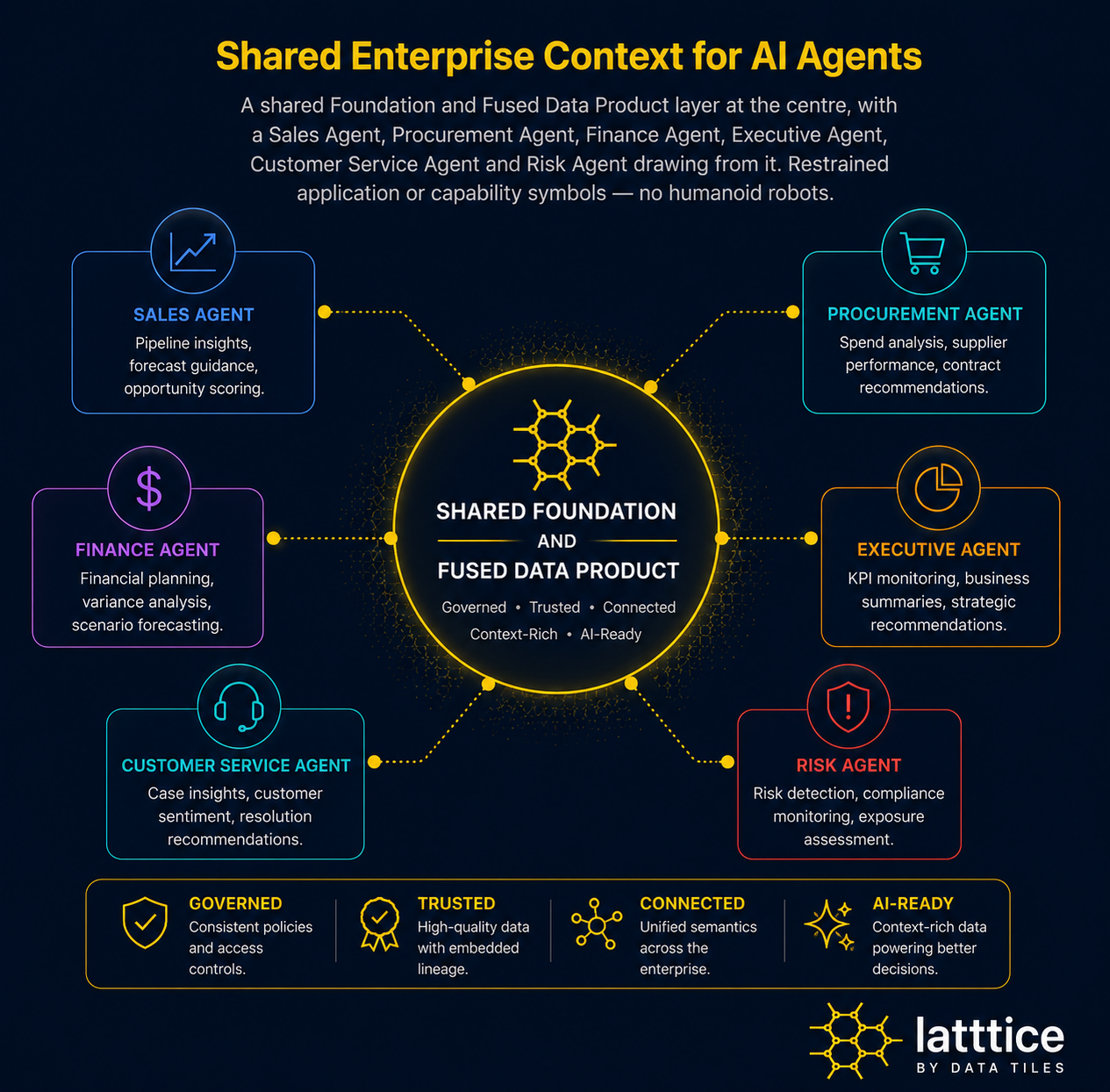
Shared Enterprise Context for AI Agents — a central Shared Foundation and Fused Data Product feeds Sales, Procurement, Finance, Executive, Customer Service and Risk Agents with governed, trusted, connected, AI-ready business context.
Fig 8Shared Enterprise Context for AI Agents. A single Foundation and Fused Data Product layer sits at the centre, supplying Sales, Procurement, Finance, Executive, Customer Service and Risk Agents with the same governed, trusted, connected and AI-ready business context. Each agent draws from one authoritative source while respecting the relevant security, policy and access controls — so organizations can deploy many agents without rebuilding the enterprise data foundation for every new use case.
Enterprise DataData ProductsAI IntelligenceEnterprise Action
Full Guide · Page 08 / 10
Business Outcomes & Differentiation
Full Guide · Page 09 / 10

One Data Product ecosystem. Many enterprise outcomes.

AI is one consumer of trusted Data Products — not the only one.
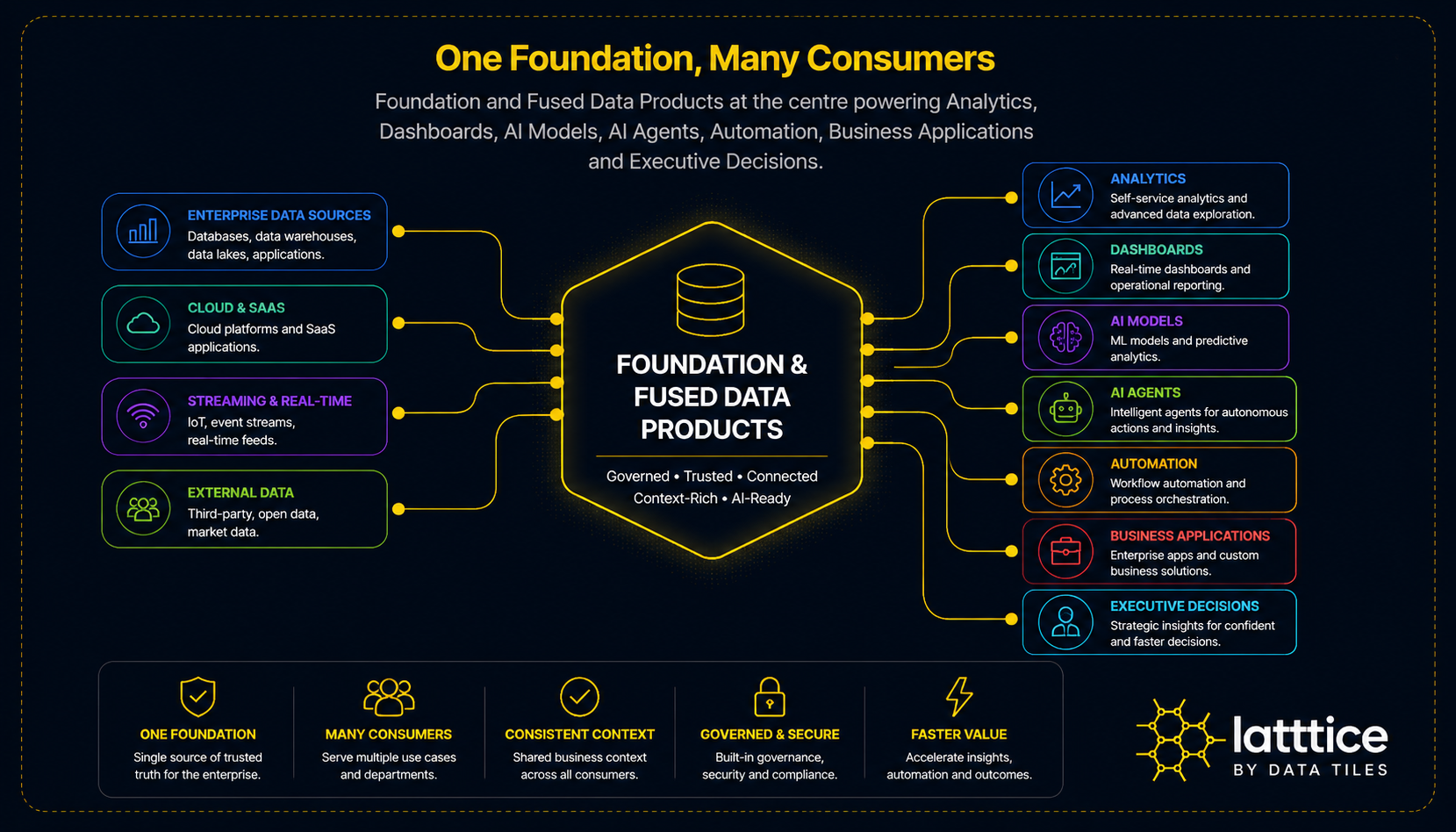
AI ModelsAI AgentsPredictive AnalyticsDigital AssistantsDashboards & ReportingBusiness ApplicationsProcess AutomationExecutive Decision Support
One Foundation, Many Consumers — Foundation and Fused Data Products at the centre, fed by Enterprise Data Sources, Cloud & SaaS, Streaming & Real-Time and External Data, and consumed by Analytics, Dashboards, AI Models, AI Agents, Automation, Business Applications and Executive Decisions.
Fig 9One Foundation, Many Consumers. Foundation and Fused Data Products sit at the centre of the enterprise data ecosystem, drawing from databases, data warehouses, data lakes, SaaS applications, streaming feeds and external data. The same governed, trusted, connected and AI-ready business context then powers analytics, dashboards, AI models, AI agents, automation, business applications and executive decisions — so one investment in Data Products serves many consumers without rebuilding the foundation for each new use case.
Why Organizations Choose Latttice
  • AI built on trusted business information
  • Reusable Foundation and Fused Data Products
  • Governance embedded in creation and consumption
  • Rapid development of new AI use cases
  • Compatibility with existing enterprise platforms
  • One trusted foundation for analytics, applications and AI
  • No requirement to replace technology already owned
Why Latttice Is Different

Most AI platforms focus on models. Most data platforms focus on storing and processing data. Latttice creates the governed Data Products that connect enterprise data to enterprise intelligence and action.

Enterprise platforms store and process data. Latttice activates it.
Enterprise DataData ProductsAI IntelligenceEnterprise Action
Full Guide · Page 09 / 10
The Latttice Enterprise AI Manifesto
Full Guide · Page 10 / 10

Every enterprise already owns data. Very few have transformed it into reusable business assets.

That is the difference between experimenting with AI and operating as an AI-enabled enterprise.

Latttice transforms fragmented enterprise data into governed Foundation and Fused Data Products. Those Data Products create the reusable business context required by AI Models, AI Agents, analytics, automation and business decisions.

Latttice works with the enterprise technology already in place. It does not require organizations to rebuild or replace their existing data ecosystem before they can move forward.

Build trusted Data Products once. Reuse them everywhere.
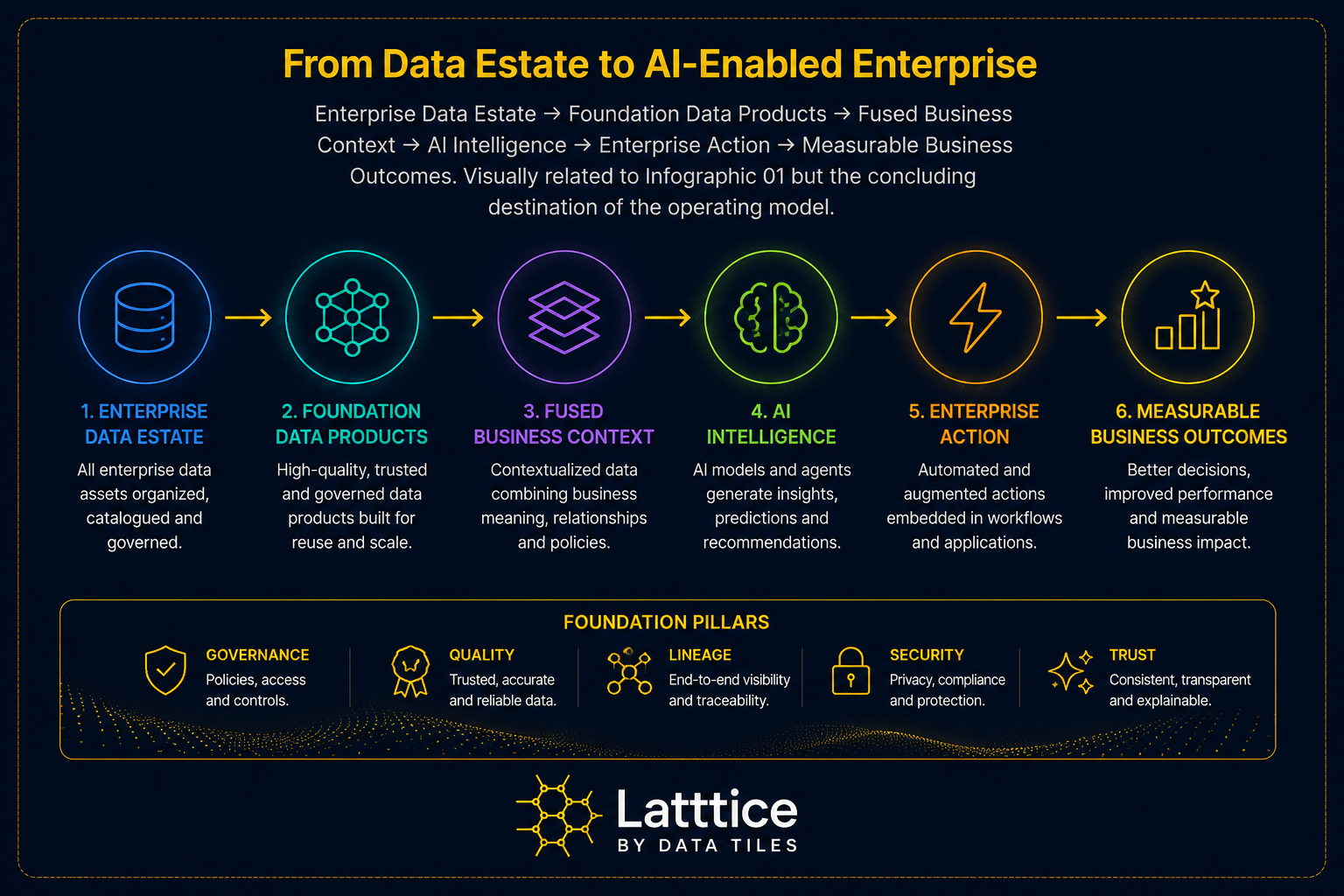
From Data Estate to AI-Enabled Enterprise — Enterprise Data Estate becomes Foundation Data Products, then Fused Business Context, AI Intelligence, Enterprise Action and Measurable Business Outcomes, supported by Governance, Quality, Lineage, Security and Trust foundation pillars.
Fig 10From Data Estate to AI-Enabled Enterprise. The journey begins with the Enterprise Data Estate — fragmented sources across the organization — and progresses through Foundation Data Products, Fused Business Context, AI Intelligence and Enterprise Action to deliver Measurable Business Outcomes. The Foundation Pillars of Governance, Quality, Lineage, Security and Trust run underneath every stage, ensuring the transformation is governed, reliable and scalable. This is the concluding destination of the operating model: data as a reusable, decision-ready enterprise capability.
Enterprise DataData ProductsAI IntelligenceEnterprise Action
Full Guide · Page 10 / 10