Latttice — the Data Product Workbench for Collibra, now on the Collibra MarketplaceLatttice — the Data Product Workbench for Snowflake70% Less Complexity with LattticeDeliver Trusted Data 80% FasterLower the Cost of Building and Operating Data Products by 70%Latttice is available where business teams work — Slack, Excel, LattticeGPTLatttice the Data Product Workbench brings trusted, fit-for-purpose data to the point of decisionsLatttice the Data Product Workbench is the bridge between the Business and Data TeamsLatttice delivers active governance at the point of data access, so trusted data products are created, controlled, and used with confidenceDesigned in North Carolina, USA

FAQ Comparison

Data Asset vs Data Product

A direct, plain-language explanation of what is being compared and why the distinction matters for decisions, governance and AI.

TL;DR

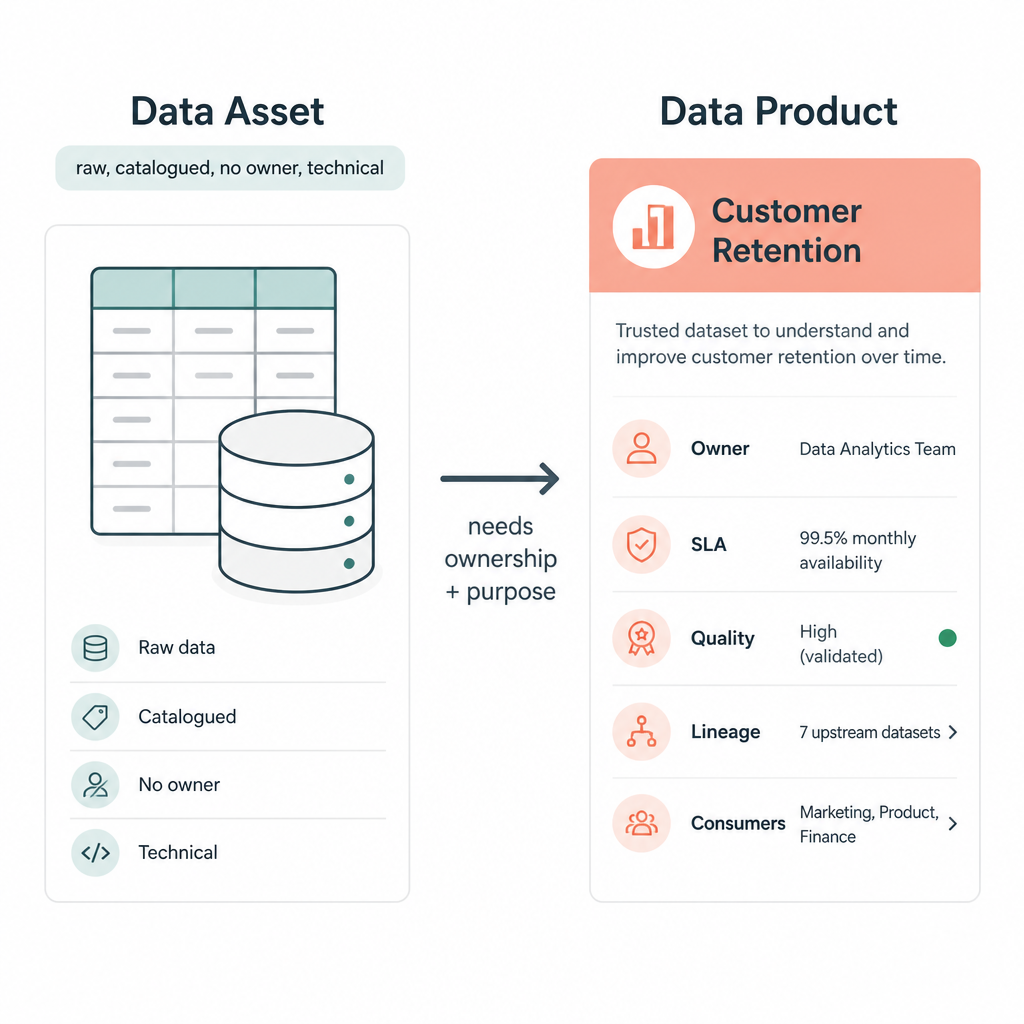
A data asset is anything of value in the data estate: a table, a file, a view, a dataset registered in a catalog. Many organizations label these as data products because they are documented and discoverable. In data mesh terms that is not enough. A data product has a named owner, a defined purpose, quality and SLA commitments, governance in context and known consumers. The asset is the raw material; the product is what the business actually consumes with confidence.

Data Asset shown as a raw catalogued dataset with no owner alongside a Data Product card for Customer Retention with owner, SLA, quality, lineage and consumers.
Interactive

Asset or product?

Use the situation to decide which one the organization actually has, and which one it needs.

Your situation

A team points to a catalogued dataset and calls it a data product because it is documented and searchable.

Data Asset
Accurate label
Data Product
Not yet

Documentation and discoverability make it a well-managed asset. Without a named owner, a stated purpose and commitments, it is not a data product in the data mesh sense.

What is it

Data Asset

A data asset is any identifiable piece of data the organization holds and tracks: a source table, an extract, a view, a curated dataset, a report backing table. Assets are typically catalogued, tagged and searchable, but ownership and fitness for a specific use are often assumed rather than committed.

What is it

Data Product

A data product, in the data mesh sense, is a governed unit of value with a named owner, a clear purpose tied to a decision or workflow, defined quality and SLA commitments, documented lineage and known consumers. It is designed to be trusted and reused, not merely found.

Side-by-side comparison

The most relevant criteria for this comparison, at a glance.

CriterionData AssetData Product
NatureA tracked piece of dataA governed unit of value
OwnershipOften unclear or shared by defaultA named product owner accountable end-to-end
PurposeGeneric; may support many usesTied to a specific decision or workflow
CommitmentsBest effort; assumed fitExplicit quality, SLA and lifecycle promises
GovernanceApplied at the source or catalogApplied in the context of use
ConsumersAnyone who finds itKnown, supported and engaged
AI readinessDepends on downstream cleanupBuilt in through context and governance

Key differences

Ownership is the dividing line

An asset can exist without anyone accountable for it. A data product cannot. The named owner is what turns a dataset into something the business can rely on.

Purpose beats generality

Assets aim to be broadly useful. Products are shaped around a specific decision or workflow, which is what makes them trustworthy in that context rather than merely available.

Commitments are explicit

A product carries quality, SLA and lifecycle promises. An asset usually does not. That is why 'we have it in the catalog' rarely translates into confident consumption.

When to use each approach

Best fit

Data Asset

Treat things as assets when you need discoverability across the estate: source tables, curated datasets, reference data. Catalogs, lineage and tagging matter here.

Best fit

Data Product

Elevate to a data product when a decision, workflow or AI use case depends on trusted data. Add the owner, the purpose, the commitments and the governance in context.

Can they work together?

Yes, and they should. Data products are typically built on top of data assets. The catalog remains valuable for discovery of raw material; the product layer is where ownership, purpose and commitments live. Confusing the two is the failure mode.

AI perspective

How AI changes the comparison

AI accelerates the cost of this confusion. Feeding models and agents from unowned assets creates fragile outcomes nobody can defend. Feeding them from data products gives AI the ownership, quality and governance context it needs to be trusted at the point of decision.

Where Latttice fits

A practical role for Latttice

Latttice does not require organizations to replace their existing data platform, warehouse, lakehouse, catalog or governance technology. It provides a zero-code Data Product Workbench that helps business teams find, connect, prepare, govern, publish and use trusted data products around real decisions. Engineering teams continue to own the platforms, controls and foundations. Business teams create the products that turn those foundations into decisions. Active governance operates across both, at build and runtime, so every product remains trusted, fit-for-purpose and ready for AI.

  • Business-built data products
  • Zero-code workbench
  • Active governance at build and runtime
  • No rip and replace
  • Trusted, governed and fit-for-purpose
  • Data at the point of decision
  • Trusted Data Plugin for AI

Frequently asked questions

Isn't every catalogued dataset a data product?

No. A catalog entry makes something a well-described asset. A data product adds an owner, a purpose, commitments and known consumers.

Do we need to turn every asset into a product?

No. Only elevate assets to products when a decision, workflow or AI use case depends on them being trusted and supported over time.

Where do data products live if not in the catalog?

They can be discovered through the catalog, but they are built, owned and operated in a product workbench where ownership, quality and governance are first-class.

How does Latttice help?

Latttice lets business teams turn assets into governed data products with owners, purpose, quality and lineage built in, without waiting on engineering.

Related guides and comparisons

Ready when you are

See Latttice with your own use case.

Bring us a business challenge, decision or data product idea and we'll show how Latttice can bring it to life — using realistic synthetic data, without requiring access to your private data.

No sales pitch. Just a tailored demonstration for your scenario.

Ready when you are

See Latttice with your own use case.

Bring us a business challenge, decision or data product idea. We'll show how Latttice can bring it to life using realistic synthetic data, without requiring access to your private data.

No sales pitch. Just a tailored demonstration for your scenario.