Latttice — the Data Product Workbench for Collibra, now on the Collibra MarketplaceLatttice — the Data Product Workbench for Snowflake70% Less Complexity with LattticeDeliver Trusted Data 80% FasterLower the Cost of Building and Operating Data Products by 70%Latttice is available where business teams work — Slack, Excel, LattticeGPTLatttice the Data Product Workbench brings trusted, fit-for-purpose data to the point of decisionsLatttice the Data Product Workbench is the bridge between the Business and Data TeamsLatttice delivers active governance at the point of data access, so trusted data products are created, controlled, and used with confidenceDesigned in North Carolina, USA
FAQ Comparison

Data View vs Data Product

A direct, plain-language explanation of what is being compared and why the distinction matters for decisions, governance and AI.

TL;DR

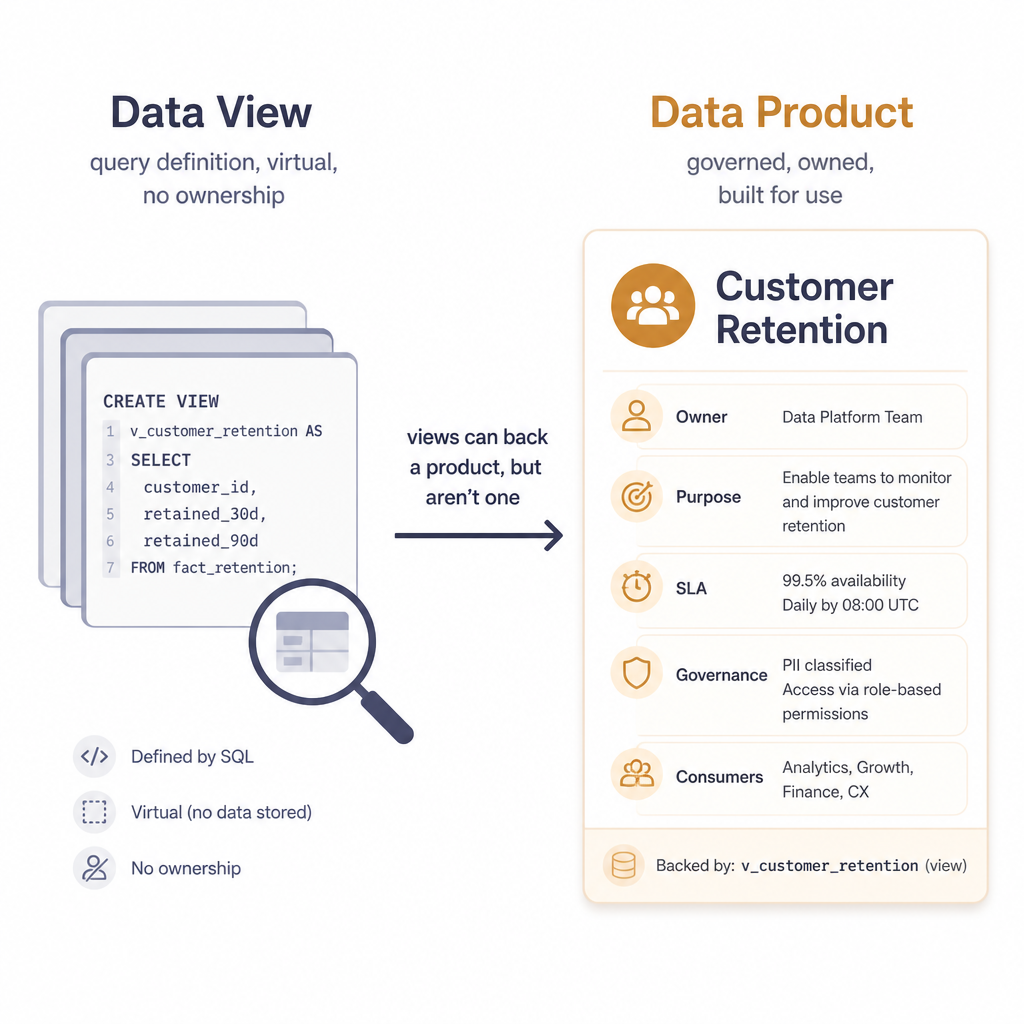
A data view is a query definition sitting on top of underlying tables. It is virtual, stores no data of its own and typically has no owner or committed purpose. Many teams call these data products because they are shareable and reusable in a warehouse. In data mesh terms they are not. A data product has a named owner, a purpose tied to a decision, quality and SLA commitments and known consumers. A view can be part of how a data product is implemented, but the product is more than the SQL.

Data View shown as a SQL view definition alongside a Data Product card for Customer Retention with owner, purpose, SLA, governance and consumers.
Interactive

View or product?

Use the situation to decide whether a view is enough or a data product is required.

Your situation

A team exposes a warehouse view and calls it a data product because other teams query it.

Data View
Useful modelling
Data Product
Not yet

Reusability alone does not make a product. Without a named owner, a purpose and commitments, other teams are consuming an unmanaged query, not a product.

What is it

Data View

A data view is a saved query that presents data from one or more tables as if it were a table itself. It is defined in SQL, evaluated when queried and inherits its behaviour from its underlying sources. It is a modelling and access convenience, not a governance artefact.

What is it

Data Product

A data product is a governed unit of value with a named owner, a clear purpose tied to a decision or workflow, defined quality and SLA commitments, documented lineage and known consumers. It is designed to be trusted and reused.

Side-by-side comparison

The most relevant criteria for this comparison, at a glance.

CriterionData ViewData Product
NatureA SQL query definitionA governed unit of value
PhysicalityVirtual; no data storedLogical product; may be materialized
OwnershipTypically none, or the authorA named product owner accountable end-to-end
PurposeWhatever the query returnsTied to a specific decision or workflow
CommitmentsDepends on the underlying tablesExplicit quality, SLA and lifecycle promises
GovernanceInherited from sourcesApplied in the context of use
AI readinessFragile; changes silently with sourcesStable, owned interface for AI to consume

Key differences

A view is an implementation detail

It is one of several ways to expose data. A data product is a contract with the business. A single product may be backed by views, materialized tables, APIs or streams; the product does not change when the implementation does.

Views inherit their fate

When an upstream column is renamed or a table is refactored, the view silently breaks or shifts meaning. A data product wraps that risk with an owner, SLAs and change management the consumer can rely on.

Consumers experience them differently

A view offers a query to run. A product offers a supported interface with a purpose, a promise and a person to talk to. That difference is what makes AI and cross-team reuse safe.

When to use each approach

Best fit

Data View

Use views to model, join and reshape data inside the warehouse or lakehouse. They are excellent for modularity and for exposing tables in more consumable shapes.

Best fit

Data Product

Use a data product when a decision, workflow or AI use case needs a stable, owned interface with commitments. The view can back it; the product is what the business consumes.

Can they work together?

Yes. A data product is often implemented on top of one or more views. The distinction is the wrapper: the ownership, purpose, commitments and governance that turn the view from a query into something the business can rely on.

AI perspective

How AI changes the comparison

AI agents and copilots need stable, owned interfaces. A view can change meaning overnight if an upstream table is refactored. A data product absorbs that change through explicit ownership and versioning, giving AI a dependable input rather than a fragile SQL definition.

Where Latttice fits

A practical role for Latttice

Latttice does not require organizations to replace their existing data platform, warehouse, lakehouse, catalog or governance technology. It provides a zero-code Data Product Workbench that helps business teams find, connect, prepare, govern, publish and use trusted data products around real decisions. Engineering teams continue to own the platforms, controls and foundations. Business teams create the products that turn those foundations into decisions. Active governance operates across both, at build and runtime, so every product remains trusted, fit-for-purpose and ready for AI.

  • Business-built data products
  • Zero-code workbench
  • Active governance at build and runtime
  • No rip and replace
  • Trusted, governed and fit-for-purpose
  • Data at the point of decision
  • Trusted Data Plugin for AI

Frequently asked questions

Isn't a well-modelled view basically a data product?

No. It is a useful modelling artefact. A data product adds ownership, a purpose, commitments and known consumers on top of whatever implementation backs it.

Can a data product be built entirely on views?

Yes. Views are a common implementation choice. The point is that the product interface, its owner and its commitments are what consumers rely on, not the underlying SQL.

Do we need to turn every view into a product?

No. Elevate to a product only when a decision, workflow or AI use case needs a stable, owned interface.

How does Latttice help?

Latttice lets business teams wrap views and tables into governed data products with owners, purpose, quality and lineage, without waiting on engineering.

Related guides and comparisons

Ready when you are

See Latttice with your own use case.

Bring us a business challenge, decision or data product idea and we'll show how Latttice can bring it to life — using realistic synthetic data, without requiring access to your private data.

No sales pitch. Just a tailored demonstration for your scenario.

Ready when you are

See Latttice with your own use case.

Bring us a business challenge, decision or data product idea. We'll show how Latttice can bring it to life using realistic synthetic data, without requiring access to your private data.

No sales pitch. Just a tailored demonstration for your scenario.