Latttice — the Data Product Workbench for Collibra, now on the Collibra MarketplaceLatttice — the Data Product Workbench for Snowflake70% Less Complexity with LattticeDeliver Trusted Data 80% FasterLower the Cost of Building and Operating Data Products by 70%Latttice is available where business teams work — Slack, Excel, LattticeGPTLatttice the Data Product Workbench brings trusted, fit-for-purpose data to the point of decisionsLatttice the Data Product Workbench is the bridge between the Business and Data TeamsLatttice delivers active governance at the point of data access, so trusted data products are created, controlled, and used with confidenceDesigned in North Carolina, USA
FAQ Comparison

Reactive Observability vs Proactive Observability

A direct, plain-language explanation of what is being compared and why the distinction matters for decisions, governance and AI.

TL;DR

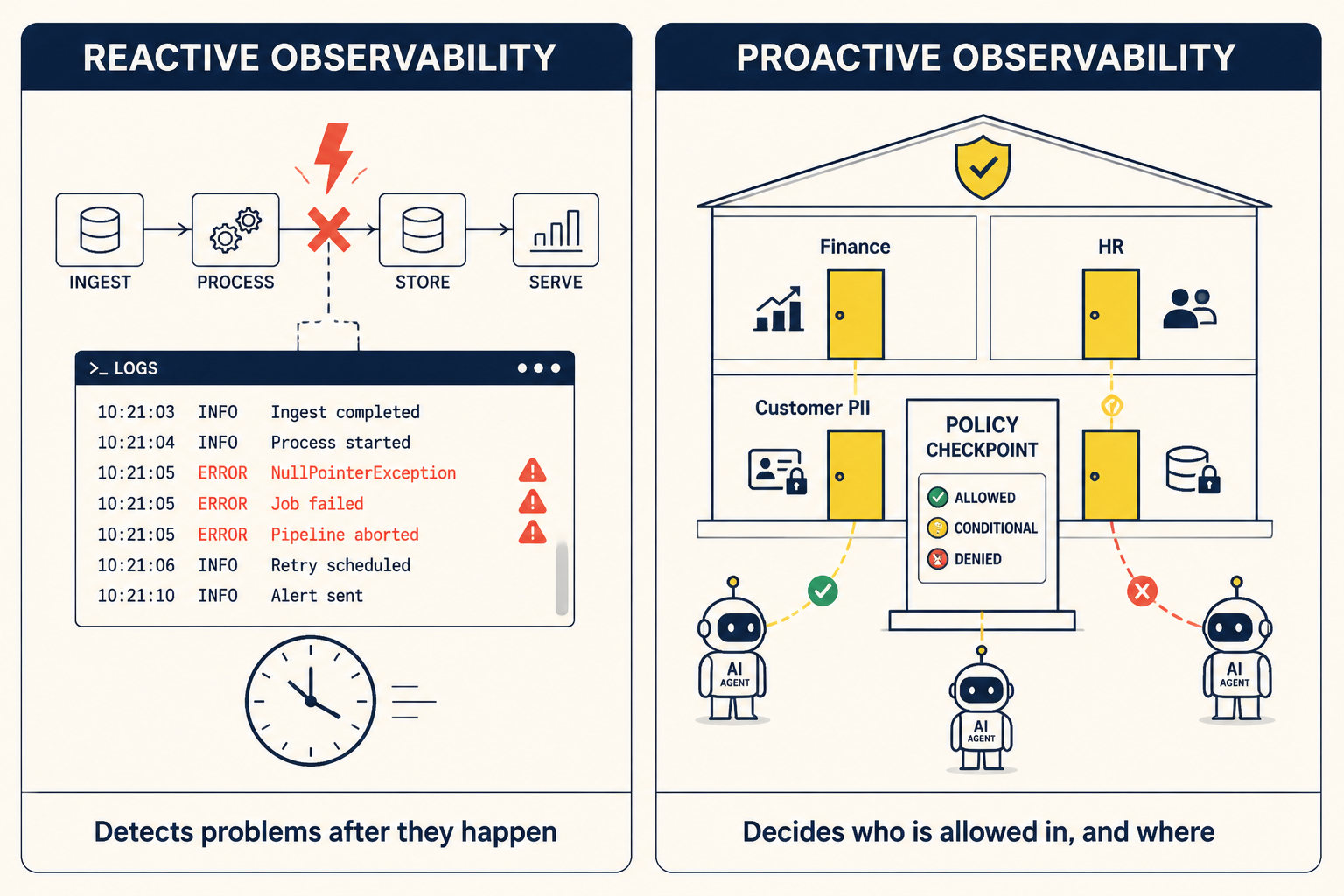
Reactive observability watches pipelines and systems, and tells you what went wrong after it happened. That is what most data observability tools do today. Proactive observability is different: it evaluates each request in the moment — who is asking, why, and what they are allowed to reach — and decides whether it should be allowed at all. For AI, reactive is not enough. The agents are already inside the building. The question is which rooms they are allowed in and what they are allowed to do within the room.

Reactive observability shown as a broken pipeline with error logs appearing after the failure, versus proactive observability shown as a building with labelled rooms and AI agents evaluated at a policy checkpoint before entry
Interactive

Which observability model fits your situation?

Pick a situation and see how reactive and proactive observability each apply.

Your situation

An ingestion job failed at 03:00 and downstream tables are stale. You need to know what happened and when.

Reactive Observability
Strong fit
Proactive Observability
Not the point

This is exactly what reactive observability is for — timelines, error logs and freshness checks. Proactive observability would not have prevented the outage; it governs consumption, not pipeline health.

What is it

Reactive Observability

Reactive observability is the model most data observability tools follow today. It monitors pipelines, jobs, freshness, schema drift and quality checks, and raises an alert when something breaks or drifts. It is essential for keeping data plumbing healthy, but it is a rear-view mirror: by the time you see the log, the bad data has usually already been served, the failed job has already missed its SLA, and the exposed field has already been read.

What is it

Proactive Observability

Proactive observability evaluates every request before it is answered. It sees who is asking (human or agent), what data they want, why they want it and the context around the request, and decides — using policy — whether the request should be allowed, allowed with constraints, or denied. It produces a per-request record of what was decided and why, so the same signal serves both real-time control and after-the-fact audit.

Side-by-side comparison

The most relevant criteria for this comparison, at a glance.

CriterionReactive ObservabilityProactive Observability
When it actsAfter the eventBefore the request is answered
Primary signalLogs, metrics, alertsPolicy decisions on each request
Primary questionWhat broke?Should this be allowed?
AnalogyCCTV reviewing footage after an incidentA door policy deciding who enters which room
Fit for pipelinesStrongComplementary
Fit for AI agentsInsufficientRequired
Evidence producedIncident timelinePer-request decision record

Key differences

After the fact versus in the moment

Reactive observability tells you a pipeline broke, a table drifted, or a job ran late. Proactive observability answers a different question at request time: should this request be allowed to happen at all, given who is asking and what they want?

Cybersecurity versus internal access

Traditional security asks 'who is knocking at the door?' — outsiders trying to get in. AI is different. The agents have already been built and deployed. They are inside the building. The real question is internal: which rooms are each of them allowed in, and which requests should be stopped even though the agent itself is trusted?

Logs versus decisions

Reactive observability produces logs and alerts you review later. Proactive observability produces decisions in the flow of work — allowed, conditional or denied — with the reason recorded. That decision record is both the control and the audit trail.

When to use each approach

Best fit

Reactive Observability

Use reactive observability to keep pipelines, jobs and datasets healthy. It remains the right model for engineering-facing monitoring of the platform itself.

Best fit

Proactive Observability

Use proactive observability everywhere AI agents, copilots and business users consume data — especially where sensitive data, regulated data or cross-domain access is involved.

Can they work together?

Yes, and they should. Reactive observability keeps the platform healthy. Proactive observability keeps consumption safe. Together they give a full picture: the plumbing is working, and every request against it was evaluated against policy before it was answered.

AI perspective

How AI changes the comparison

AI changes the shape of the problem. Human consumption is slow, predictable and reviewable after the fact. Agent consumption is fast, unpredictable and impossible to review request-by-request in retrospect. Reactive observability cannot keep up with agents asking thousands of questions a minute in combinations no one anticipated. Proactive observability — policy evaluated per request, with a decision recorded — is what makes AI on enterprise data safe, explainable and auditable.

Where Latttice fits

A practical role for Latttice

Latttice does not require organizations to replace their existing data platform, warehouse, lakehouse, catalog or governance technology. It provides a zero-code Data Product Workbench that helps business teams find, connect, prepare, govern, publish and use trusted data products around real decisions. Engineering teams continue to own the platforms, controls and foundations. Business teams create the products that turn those foundations into decisions. Active governance operates across both, at build and runtime, so every product remains trusted, fit-for-purpose and ready for AI.

  • Business-built data products
  • Zero-code workbench
  • Active governance at build and runtime
  • No rip and replace
  • Trusted, governed and fit-for-purpose
  • Data at the point of decision
  • Trusted Data Plugin for AI

Frequently asked questions

Is reactive observability wrong?

No. It is essential for pipeline health. It is just not sufficient on its own once AI agents are consuming data at machine speed.

Is proactive observability the same as access control?

It uses access control, but goes further. Access control decides yes or no. Proactive observability evaluates purpose and context per request, records the decision and produces the audit trail.

How does this relate to active governance?

Proactive observability is how active governance is felt at runtime — every request evaluated against policy, with the decision captured as evidence.

Do we need to replace our data observability tools?

No. Keep them for pipelines and platform health, and add proactive observability at the consumption layer where humans and agents actually ask for data.

Related guides and comparisons

Ready when you are

See Latttice with your own use case.

Bring us a business challenge, decision or data product idea and we'll show how Latttice can bring it to life — using realistic synthetic data, without requiring access to your private data.

No sales pitch. Just a tailored demonstration for your scenario.

Ready when you are

See Latttice with your own use case.

Bring us a business challenge, decision or data product idea. We'll show how Latttice can bring it to life using realistic synthetic data, without requiring access to your private data.

No sales pitch. Just a tailored demonstration for your scenario.