Latttice — the Data Product Workbench for Collibra, now on the Collibra MarketplaceLatttice — the Data Product Workbench for Snowflake70% Less Complexity with LattticeDeliver Trusted Data 80% FasterLower the Cost of Building and Operating Data Products by 70%Latttice is available where business teams work — Slack, Excel, LattticeGPTLatttice the Data Product Workbench brings trusted, fit-for-purpose data to the point of decisionsLatttice the Data Product Workbench is the bridge between the Business and Data TeamsLatttice delivers active governance at the point of data access, so trusted data products are created, controlled, and used with confidenceDesigned in North Carolina, USA
FAQ Comparison

Data Observability vs Data Product Workbench

A direct, plain-language explanation of what is being compared and why the distinction matters for decisions, governance and AI.

TL;DR

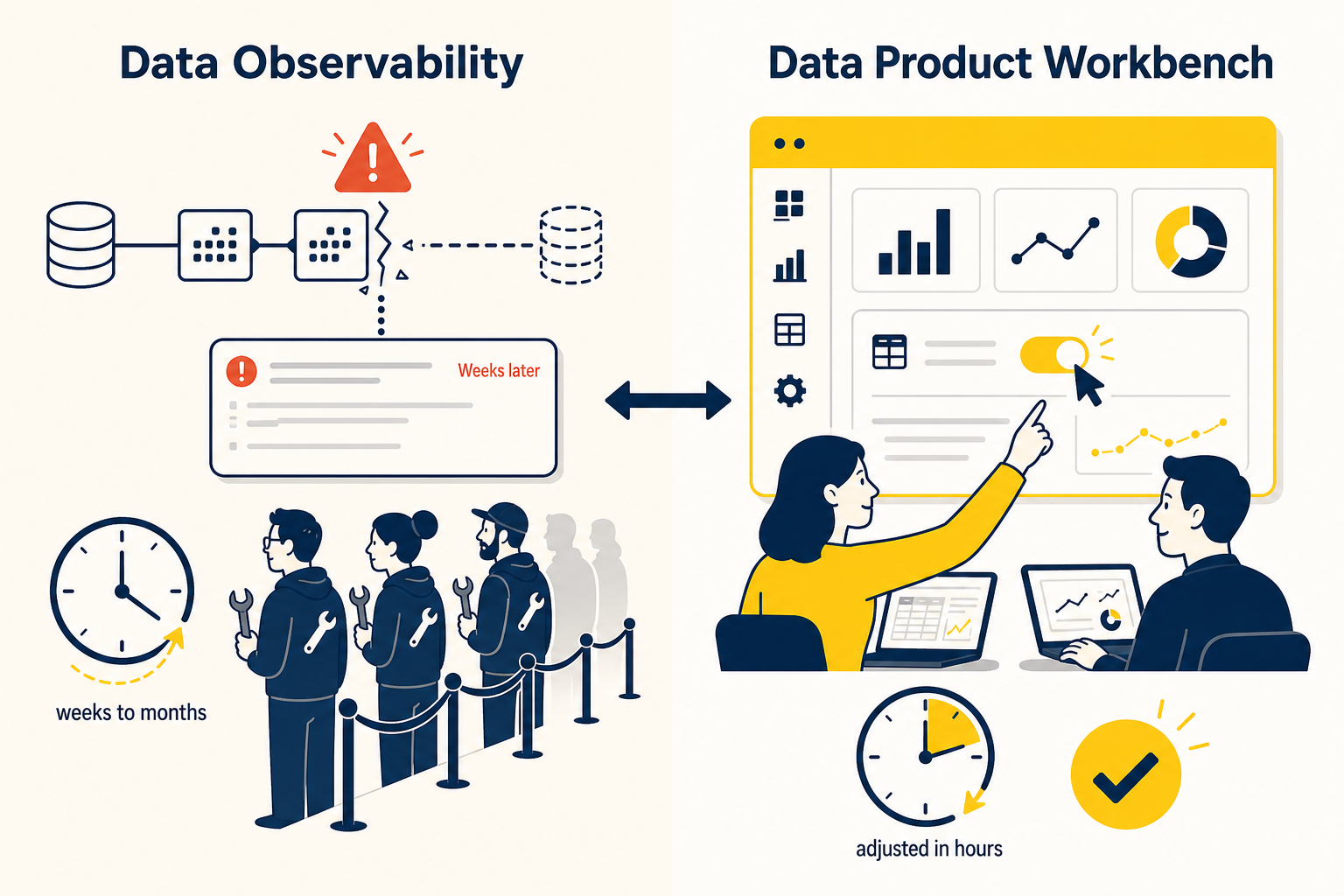
Data observability is the engineering discipline of monitoring pipelines and logging what went wrong. A Data Product Workbench is the business-facing surface where data products live — where the people who own them can see who is using what, and adjust access, definitions and controls immediately. Traditional data observability logs an incident and hands it to data engineers to triage; that loop often runs in weeks to months. A workbench lets the business team observe and adjust in hours or days. With AI moving at machine speed, the slow loop is no longer acceptable.

Split infographic: data observability shown as a broken pipeline with an alert logged weeks later and engineers queued to triage, versus a data product workbench where a business user toggles a control and adjusts a product in hours
Interactive

Which surface fits your situation?

Pick a situation and see how data observability and a Data Product Workbench each apply.

Your situation

A nightly ingestion job failed and downstream tables are stale.

Data Observability
Strong fit
Data Product Workbench
Not the point

This is exactly what data observability is built for — detect the failure, alert the engineering team, capture the incident timeline. The workbench is not the surface for platform-level plumbing.

What is it

Data Observability

Data observability monitors pipelines, jobs, freshness, schema drift and quality checks, and raises an alert when something breaks or drifts. It is essential for keeping the engineering platform healthy. But the response loop is engineering-owned: an issue is detected, ticketed, triaged, prioritised and eventually fixed by data engineers in a later iteration — often weeks or months after the business first felt the impact.

What is it

Data Product Workbench

A Data Product Workbench is the business-owned surface for the data products themselves. It observes what is happening at the product level — who is consuming what, which fields are being accessed, which policies fired — and lets the product's business owner adjust definitions, access and controls directly, in hours or days, without an engineering ticket. Latttice does include a data-observability function so logs are still captured; the difference is the workbench closes the loop where the decision actually lives.

Side-by-side comparison

The most relevant criteria for this comparison, at a glance.

CriterionData ObservabilityData Product Workbench
What it watchesPipelines, jobs, tablesData products and their consumption
Who acts on itData engineersBusiness product owner
Response loopWeeks to monthsHours to days
Primary outputAlert / incident ticketDirect adjustment to the product
What 'fix' meansNew engineering iterationChange made in the workbench
Fit for AI speedToo slow on its ownDesigned for it
RelationshipFeeds the workbenchCloses the loop on what observability sees

Key differences

Log-and-triage versus see-and-adjust

Traditional data observability logs an issue and hands it to a queue of data engineers. A workbench lets the business owner see the same signal in context and change the product — access, definition, policy — right there. Same problem, very different loop length.

Weeks-to-months versus hours-to-days

The engineering loop is: detect, ticket, triage, prioritise, schedule, iterate, deploy. That is weeks or months in most organizations. In a workbench the person accountable for the product makes the change in the moment, and the change is governed by design.

AI makes the slow loop unacceptable

When humans consumed data on weekly rhythms, a multi-week fix was tolerable. Agents ask thousands of questions a minute and make decisions on the answers. A weeks-long triage cycle means an AI has been acting on the wrong basis the whole time. The loop has to compress.

When to use each approach

Best fit

Data Observability

Keep data observability for the platform layer — pipelines, jobs, infrastructure health. That is what it is built for and it remains essential.

Best fit

Data Product Workbench

Use a Data Product Workbench wherever business teams own data products that humans and AI consume, so who can see what and why can be observed and adjusted in the moment.

Can they work together?

Yes — and they should. Latttice includes observability so pipeline and product signals are still captured. The workbench then turns those signals into something the business owner can act on immediately, rather than something that sits in an engineering backlog. Observability feeds the workbench; the workbench closes the loop.

AI perspective

How AI changes the comparison

AI collapses the tolerable response time. A data issue that took engineers six weeks to fix used to inconvenience a few analysts; today it means an agent is making automated decisions on the wrong data for six weeks. Observability that only logs is not enough — the business owner needs to see, decide and adjust in the same surface, in the same session.

Where Latttice fits

A practical role for Latttice

Latttice does not require organizations to replace their existing data platform, warehouse, lakehouse, catalog or governance technology. It provides a zero-code Data Product Workbench that helps business teams find, connect, prepare, govern, publish and use trusted data products around real decisions. Engineering teams continue to own the platforms, controls and foundations. Business teams create the products that turn those foundations into decisions. Active governance operates across both, at build and runtime, so every product remains trusted, fit-for-purpose and ready for AI.

  • Business-built data products
  • Zero-code workbench
  • Active governance at build and runtime
  • No rip and replace
  • Trusted, governed and fit-for-purpose
  • Data at the point of decision
  • Trusted Data Plugin for AI

Frequently asked questions

Does Latttice have data observability?

Yes. Latttice includes an observability function so logs and consumption signals are captured. The difference is that the workbench lets the business owner act on those signals in hours, rather than routing them into an engineering backlog.

So do we still need data observability tools?

For the platform layer, yes — pipeline, job and infrastructure monitoring is still essential. The workbench is not a replacement for that; it is the missing loop at the product layer.

Why is the engineering loop too slow for AI?

AI agents act on data continuously. A six-week triage cycle means an agent has been making decisions on the wrong basis for six weeks. The response loop has to compress from months to hours, and that only happens if the person accountable for the product can act directly.

How does this relate to active governance?

The workbench is where active governance is felt day-to-day — the business owner sees what is happening on their product and adjusts policy, access and definitions with governance applied by design.

Related guides and comparisons

Ready when you are

See Latttice with your own use case.

Bring us a business challenge, decision or data product idea and we'll show how Latttice can bring it to life — using realistic synthetic data, without requiring access to your private data.

No sales pitch. Just a tailored demonstration for your scenario.

Ready when you are

See Latttice with your own use case.

Bring us a business challenge, decision or data product idea. We'll show how Latttice can bring it to life using realistic synthetic data, without requiring access to your private data.

No sales pitch. Just a tailored demonstration for your scenario.